Blog

  • What’s love got to do with it?

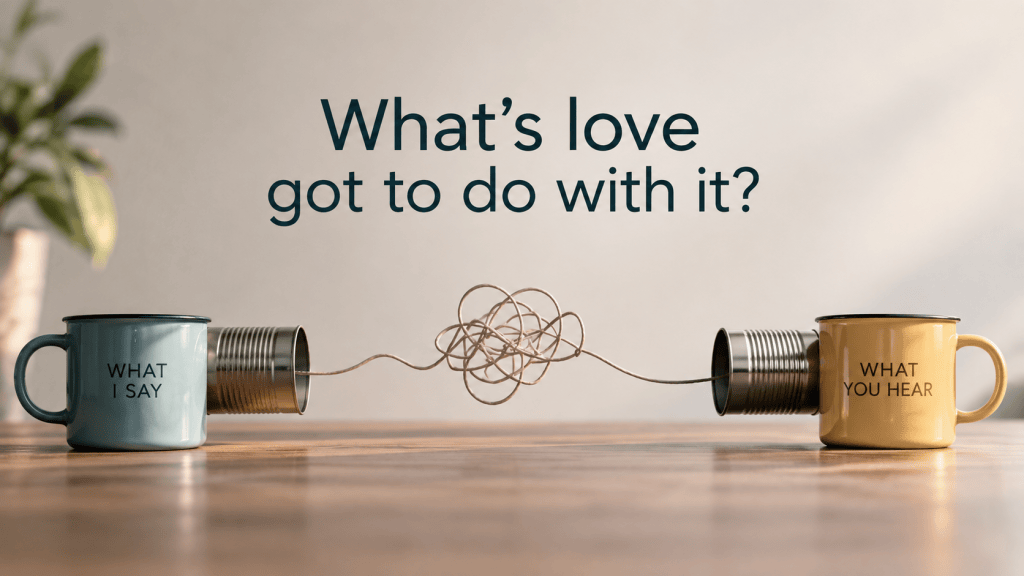
    What’s love got to do with it?

    In 2010, I went on a pre-marriage course. My now wife and I were engaged to be married that summer, and the course had been recommended to us as a way of exploring some of the things we perhaps hadn’t thought about yet.

    One of the things I came away with was a book called The Five Love Languages by Gary Chapman. The premise was fairly simple: we don’t all give and receive love in the same way. Chapman described five broad languages: words of affirmation, quality time, receiving gifts, acts of service and physical touch.

    At the time, I was mostly interested in not being terrible at marriage. Software testing certainly didn’t enter into it.

    Years later, a Facebook memory reminded me of the book and got me thinking about it again. Somewhere along the way, I started wondering whether something I’d encountered in a completely different part of my life might help me think about communication at work. I started exploring some of that in my 2018 blog, In My Mind, My Body and My Soul, and the idea eventually became my first accepted conference talk: What’s love got to do with it? A communication heuristic.

    One of the versions from the COVID years is still online, so you can watch 2020 me explain it if you fancy. You can also have a good laugh at the state of my lockdown video background, complete with my kids shouting at each other somewhere off camera. Lovely.

    The reason I ended up back here was a conversation with my friend Kristoffer Nordström. We were rubber ducking ideas for conference abstracts for 2027 when this old talk resurfaced. That sent me back to the slides, handout and recording to see what I make of the ideas now.

    Watching the recording was slightly strange. Remote interaction was still something many of us were figuring out at the time. Six years later, remote and distributed working is simply part of the landscape for many of us, and some of the signals available to us when we communicate have changed with it. That makes the question at the heart of all of this feel perhaps even more relevant now:

    how often do we communicate with people in the way that works for us and assume it works for them too?

    Why did this matter at work?

    Around the time I started developing these ideas, I was in my first job as a manager. I was still a testing practitioner, now with responsibility for other people as well. That made some of the differences between people rather difficult to ignore.

    Software development depends on people being able to communicate what they know. A lot of the work involves trying to understand things together, including things that might be uncertain, uncomfortable or contested. Much of what a team gets to learn depends on somebody feeling able to put information into the conversation in the first place.

    How we communicate can influence what happens next. Someone who feels dismissed when they raise a concern might think twice about raising another. Feedback can lose some of its value when its delivery gets in the way. Even a well-intentioned attempt to help can leave somebody feeling that their work has been taken away from them.

    Teams develop a culture around these interactions too. Expectations form around how directly people speak and what happens when somebody challenges something. We bring our own experiences and preferences into those environments, and it can be surprisingly easy to treat our version of normal as everyone else’s. The Five Love Languages gave me a way to explore some of that.

    It was always supposed to be a heuristic

    A heuristic helps us think without prescribing an answer. The question I used when I first explored this was: what might I do in this situation?

    That word might matters. Discovering that Dave over here is a “quality time person” doesn’t suddenly unlock the secret to communicating with Dave forever. At best, we have another piece of information that might help us understand him. There’s still a person and a situation to account for.

    That was part of the attraction for me. The Five Love Languages gave me something to think with. I wasn’t particularly interested in working methodically through all five, and I’m still not. Pulling on a few of them gives us enough to see where the questions start to get interesting.

    Appreciation isn’t universal

    Take words of affirmation. Someone has done something good and you want to recognise it. What do you actually do?

    For one person, hearing their name called out in front of the entire company might be brilliant. They feel seen and their contribution has been recognised. Someone else might want the ground to swallow them up. That second person might appreciate a direct message or a conversation with somebody whose opinion they respect, particularly when that person can tell them specifically what they valued about their contribution.

    Split illustration showing the same person receiving recognition in different contexts: uncomfortable with a public “Great work” announcement, and appreciating a private message thanking them specifically for their contribution.
    Split illustration showing the same person receiving recognition in different contexts: uncomfortable with a public “Great work” announcement, and appreciating a private message thanking them specifically for their contribution.

    Even once we think we’ve understood that somebody values words of affirmation, there’s still plenty we don’t know. A public shout-out and a quiet word can both be expressions of appreciation while feeling completely different to the person receiving them.

    Words can also carry more than praise. Workplace banter is an obvious example. Something intended affectionately can land rather differently when the other person doesn’t share our understanding of the joke. Sarcasm and passive aggression make that territory more difficult again.

    There’s a bias sitting underneath this that is easy to miss. I know how I would receive something, and that knowledge is immediately available to me. Those of us working in software are already accustomed to trying to think beyond ourselves through things like personas and different user perspectives. It’s curious how easily we can forget to do the same with the people on the other side of our communication.

    What does your attention look like?

    Quality time raises similar questions. You’re talking while the other person is typing on their laptop or looking at their phone. They’re physically present, and they might even be listening, but you have no idea whether you actually have their attention.

    Perhaps that doesn’t bother you at all. Having somebody pair with you on a problem while you’re both doing things could be enormously valuable. In another situation, you might value ten uninterrupted minutes where the laptop closes and the person you’re speaking to is visibly focused on the conversation.

    Distributed working gives us even more variations on what presence can look like. We can work closely with people we rarely meet in person and have rich conversations through text. We can also sit in the same video call and come away with completely different experiences of how engaged everybody was. There’s ambiguity in all of that, and I find it really interesting.

    Something similar happens when somebody comes to us with a problem. They might want help working through it, or simply space to talk. I’ve certainly offered solutions to people who weren’t asking me to solve anything. Understanding what somebody needs from the conversation can be more useful than immediately demonstrating that we’re able to help.

    Helping can become unhelpful

    Acts of service sounds uncomplicated. Somebody needs something, and you help them. What that help looks like is where things become less straightforward.

    My dad gave me an example of this long before I had any reason to think about it in these terms. Before he became a vicar, he was a French and German teacher. When I took my French homework to him and effectively asked him to answer the question for me, he wouldn’t. He helped me work it out and find my own path. At the time, I’m fairly sure I’d have still preferred the answer. In hindsight, he gave me the chance to actually learn something.

    People who are generous with their time or knowledge can also become the people everybody relies on. That can look positive for quite a while, particularly when we celebrate the workplace “rock star” who takes everything on. Eventually, the cost can start to show, and the team can become dependent on the very behaviour it has been celebrating.

    Receiving gifts and physical touch can prompt their own questions, and I explored both in the original material. I don’t think we need to march through all five here to make the point. The value for me comes from what happens when we stop treating the label as the answer and start getting curious about the person.

    Sometimes we simply don’t know

    Early in my career, I worked in games testing. I remember some colleagues joking around one day when the conversation turned to priests, and it became pretty uncomfortable.

    My dad’s a vicar, as I mentioned earlier, and they didn’t know that. I just sat there getting increasingly angry and offended. I didn’t say anything, so the conversation carried on.

    I can still remember how that made me feel. They were missing a piece of context that was highly relevant to how I was experiencing the conversation. Offensive comments were still offensive. The experience showed me how easily people can be part of the same interaction while having very different information about what is happening between them.

    We can’t know everything about the people we work with, and nor should we expect to. Getting to know them gives us more to work with. This matters because a team can only respond to the information that makes it into the conversation. Somebody who has been talked over enough times might eventually keep the next question to themselves. When challenging a decision repeatedly leads somewhere unpleasant, perhaps the next risk doesn’t get raised.

    The Five Love Languages are not five types of people

    There is a workplace-specific adaptation of the book called The 5 Languages of Appreciation in the Workplace by Gary Chapman and Paul White. I didn’t know it existed when I developed these ideas.

    My route into this was the relationship book I’d encountered on the pre-marriage course in 2010. I also had a handout from that course, which I later adapted into ordinary workplace situations when I started exploring the idea through software testing.

    The questions asked people to choose between different ways they might experience the languages. The score gave them somewhere to start, although comparing answers was where things became more useful. Why had two people chosen differently? What did one person see in an option that somebody else didn’t?

    I’ve still got that handout, and I’ve included it here if you fancy having a go. Try it as a prompt, perhaps with somebody you work with, and see what the differences in your answers give you to talk about.

    Even people who appear to share a language can have very different preferences. Someone who values words of affirmation might love a public shout-out while somebody else would much rather receive a private message. Someone who relates to physical touch might enjoy a high five and have absolutely no interest in being hugged.

    The category gets the conversation started. The conversation tells us far more about the person.

    Communication has a context

    Communication at work happens inside teams with their own dynamics and cultures, between people who bring different experiences and expectations with them. Increasingly, those interactions also happen across locations and through a mixture of written and spoken communication.

    That changes what’s available to us. Intonation can completely alter the meaning of a few words when they’re spoken, then disappear when the same words are typed into a chat window. A short, direct message might feel wonderfully clear to one person and abrupt to another. Expectations can also differ around how quickly a message needs a response or whether a disagreement is better handled in writing or through a conversation.

    Culture plays into this in ways that go well beyond geography. Teams and organisations develop habits around how people communicate. New people arrive and have to make sense of those signals while bringing expectations of their own. How comfortable somebody feels saying that they don’t understand something can be influenced by what they have already seen happen when other people do it.

    Remote and distributed working adds more variation to something that was already complicated. Some signals become harder to see while other forms of interaction become possible. A carefully written message can give somebody time to think before responding. There are other conversations where hearing somebody’s voice might make all the difference.

    There isn’t a universally better way to communicate. We need enough awareness of the people and the situation to choose something appropriate, accepting that we won’t always get it right.

    So, what’s love got to do with it?

    Coming back to these ideas seven years later, identifying somebody’s “love language” feels less important to me than it once did. What has stuck with me is how easily we can mistake our own communication preferences for something universal.

    I was relatively new to management when I first started thinking about this in a workplace context, and perhaps that’s part of why it resonated with me. I was learning how much of working with people involved paying attention, adjusting and sometimes recognising that the way I’d approached something hadn’t landed as I expected.

    That lesson reaches well beyond management. Software development depends on people sharing what they know, particularly when that information introduces uncertainty or disagreement. Quality depends on useful information being surfaced and acted upon. How we communicate around the work can influence which signals make it through and which disappear.

    The Five Love Languages helped me notice some of those differences. They also gave me a reason to talk to people about them, which has proved considerably more useful than knowing which label came out on top.

    That brings me back to the word I chose for the original title: heuristic. I wanted something that could help me think about what I might do in the situation I was actually in. Looking back, I think that’s why the idea has stayed with me.

    Seven years later, the question still feels useful: what might I do in this situation?

  • When “Done” Stopped Being Done

    When “Done” Stopped Being Done

    Recently, whilst watching The Not Very Grand Tour, I found myself reaching for my notebook. The opening has stayed with me ever since.

    “We’re here to celebrate the brilliance of the engine, because I think I’m right in saying that an engine is the most complicated and yet most dependable thing that most of us will ever own.

    If you were to leave your mobile phone out in the searing sun of Death Valley for eight hours, it would stop working. But a car engine is expected to spring immediately into life or it’s not good enough.

    Imagine if you’d left your dishwasher out in the Arctic winter all day. That wouldn’t work. Your printer won’t work anywhere, and yet a modern car engine can have over 800 parts and they just never let you down.”

    “Car makers routinely test down to minus 40. At those temperatures, a human being would get hypothermia and die within five minutes. But a car engine has to work perfectly.”

    Excerpt adapted from The Not Very Grand Tour, Series 1, Episode 1, “The Glory and The Power” (Prime Video).

    I haven’t been able to shake that opening and how it applies to software development.

    Software can evolve, improve, and adapt in ways that physical products never could. In many respects, that is exactly what we’ve spent decades trying to achieve. What stayed with me most was the expectation surrounding all that engineering.

    For all their complexity, we expect engines to work. Most of us couldn’t explain every moving part, but we trust them without needing to. If an engine fails to start, we don’t shrug and wonder whether the next update will sort it out. We consider that a failure rather than an inconvenience.

    Our relationship with software today feels very different. That applies to how we build it, consume it, maintain it, update it, and ultimately define quality around it. Our ability to continuously improve products has created enormous opportunities, but I also wonder whether it has changed our relationship with confidence, ownership, and what “good enough” means.

    When Completion Felt Different

    I remember a time when reaching the end of something felt different.  Whether it was better is debatable, but it certainly felt different.

    Projects had clearer beginnings, middles, and endings. Release notes felt significant because releases themselves were significant. I still remember sitting at EuroSTAR 2013 during the closing session when my HTC One lit up with a notification for a new OS update. I was genuinely excited to read what had changed because those updates felt meaningful. They represented progress that you could see, understand, and look forward to.

    That same feeling extended beyond software. I now own my Dad’s leather-bound Encyclopaedia Britannica from 1988. It was already out of date the moment it was printed, and everybody understood that. Yet it represented something that feels increasingly rare today: a coherent body of knowledge. It was a shared reference point. People accepted its limitations whilst also accepting that, for the time, it represented the best understanding we collectively had.

    Today, most of our products, services, and information sources exist in a state of continuous evolution. Software updates arrive weekly, daily, or sometimes several times a day. Documentation is maintained rather than published because living documentation is rightly seen as the goal. Products evolve through countless small iterations, while features appear, disappear, and change with very little ceremony.

    This has solved genuine problems, although I think we’ve lost something along the way: a sense of completion. I miss the satisfaction of seeing a piece of work through and the confidence that came from accepting trade-offs, making decisions and standing behind the result. I miss the collective understanding that this was the thing we had built. Everyone understood what it did well and where its limitations lay, along with the decisions that had shaped it. There was a shared acceptance that this chapter was complete, and we could turn our attention to the next one.

    Perhaps that was inevitable. After all, the world that produced those encyclopaedias, those release notes, and those earlier generations of software was very different from the one we live in today. We can’t return to that world, nor would I want to. The challenge is recognising what we’ve learned along the way and which of those lessons we need to retain as we continue to move forward.

    What We Gained

    It would be easy to read this as nostalgia. It isn’t.

    The move towards continuous improvement has delivered genuine benefits. Security updates and accessibility improvements can reach people faster. Bugs can be fixed sooner. Products can evolve alongside customer needs instead of forcing people to wait months or even years for meaningful improvements.

    Cloud computing, observability, feature flags, canary releases, continuous delivery and AI-assisted development have helped make this possible. They’ve lowered the barriers to experimentation and shortened the distance between an idea and a working solution. We can learn from reality rather than rely on prediction alone.

    The world that produced boxed software, fixed-time encyclopaedias and lengthy release cycles also came with limitations and missed opportunities. There are many things we were right to leave behind. Being able to improve something later gave us options that weren’t previously available to us. We can respond quickly when circumstances demand it and learn from what actually happens when the software reaches the people using it.

    Many of the practices we celebrate today have emerged because organisations recognised that certainty was often an illusion. They created more opportunities to learn and adapt as our understanding developed.

    How Completion Changed

    The ability to improve something later inevitably changes the decisions we make today. Learning and adapting as we go means making those decisions knowing another iteration remains possible.

    If a product can be updated tomorrow, there is less pressure to get everything right before release. We can respond to new information, revisit mitigations and adjust our approaches as our understanding develops. That flexibility gives us more options when thinking about risk and how we develop software. It can also make deferring a decision feel less consequential than it might once have done.

    Iteration itself isn’t the problem. Some of the most significant advances in software delivery have come from embracing feedback and learning as we work rather than trying to predict everything upfront. That same adaptability has changed how we think about quality. We accept technical debt knowing we can revisit it and release products that are “good enough” for now. Sometimes those compromises are deliberate and informed. They can also be shaped by delivery pressures, commercial realities or simple optimism about the next iteration.

    This discussion can easily be oversimplified as a choice between quality and speed, when most teams want both. The tension is really between certainty and adaptability, and the trade-offs we make between them. As our ability to respond to change has grown, so has our ability to defer decisions or accept risks that teams may once have felt compelled to resolve before release.

    Those earlier approaches weren’t necessarily better. The environment has changed, and our relationship with quality has changed alongside it.

    The Explosion of Context

    These changes aren’t limited to software. They extend to how we learn, how we communicate, and ultimately how we decide what to trust.

    Earlier, I reflected on my Dad’s Encyclopaedia Britannica representing a coherent body of knowledge. A shared reference point that people collectively understood, whilst accepting it represented the best understanding available at that moment in time.

    Today, we’ve largely accepted that anything we publish is already beginning to age. Documentation is expected to evolve, articles are revised, knowledge bases are living resources, AI can generate answers in seconds, and social media continuously reshapes how those answers are interpreted.

    We have access to more information than any previous generation, but we also have access to more competing interpretations of that information. Access to knowledge has become dramatically more democratic. We can learn from experts on the other side of the world, collaborate across continents, and build products with people we may never meet in person. The opportunities are extraordinary, although that abundance also makes understanding harder. The amount of context required to understand almost anything has grown enormously.

    Software development reflects the same pattern. Every week seems to introduce a new framework, methodology, AI capability, or prediction about the future of engineering. Before organisations have fully understood one wave of change, another has already arrived behind it. The challenge is working out what deserves our attention and trust based on what applies to our own context.

    There’s a growing temptation to treat every successful practice as universally applicable. Organisations copy engineering cultures without sharing the same constraints. Teams adopt delivery models because successful companies use them, not because they solve the problems immediately in front of them. AI-generated recommendations can reinforce the same behaviour, confidently producing answers without understanding the environment in which those answers will ultimately be applied.

    The amount of information has increased, but the context required to interpret it has increased even faster. Abstraction becomes essential. Nobody can understand every dependency, framework, AI suggestion, emerging technology, or architectural decision. We increasingly rely on people, tools, and systems to help us navigate that complexity, which makes trust more important than ever.

    That thought crystallised for me after reading a recent article by Kristoffer Nordström, who captured it perfectly:

    “Trust is a lubricant. Where it’s high, you can leave things unsaid, assume good faith, and skip the paperwork. Where it’s low, you write everything down, prove everything, and get it stamped.”

    (Read Kristoffer’s article, A Grand Unified Theory of Metal and Software Testing)

    I keep coming back to that observation because it feels increasingly relevant to software development. Trust doesn’t remove the need for evidence, replace accountability, or eliminate the need for testing, observability, and verification. Instead, it allows teams to move with confidence because they understand the systems and people they’re working with.

    As our systems become more capable and more complex, trust becomes one of the few things that allows us to continue moving forward without being overwhelmed by the sheer volume of context surrounding us.

    What Remains True

    One of the most interesting conversations I had at EuroSTAR 2026 was with an attendee returning to the conference after more than 15 years. What they found both reassuring and frustrating was how familiar many of the discussions still felt.

    The tooling, terminology, and scale had all changed, yet the underlying conversations sounded familiar. People were still discussing uncertainty, wrestling with quality, and balancing delivery pressure against confidence. Testers, developers, product managers, and leaders are still trying to understand complex systems well enough to make informed decisions.

    That observation stayed with me because it reinforced something I’ve believed for a long time. Good principles tend to outlive the technologies that inspired them. The mechanics, implementation, and constraints change, yet the underlying human challenge often remains consistent.

    We still need to understand risk and explore products, uncovering useful information that gives people enough confidence to make informed decisions. Quality has never been a fixed destination. It’s always been contextual, shaped by purpose, consequence, expectation, value, and risk.

    Those conversations haven’t become less important because AI exists. If anything, they’ve become more important because the pace of change has increased so dramatically. The physical act of building software will continue to evolve. The need to understand what we’re building and why we’re building it, and whether we should release it, remains exactly the same.

    The Opportunity in Front of Us

    I’m optimistic. AI won’t solve software development, but moments like this give us permission to revisit assumptions that have become embedded in our industry over the years.

    AI represents one of the most significant shifts many of us will experience during our careers. It’s changing how software is designed, built, reviewed, tested, and maintained. More importantly, it’s changing the economics of creation. The effort required to turn an idea into working software has compressed dramatically. That’s remarkable progress. But it immediately raises another question: what do we choose to do with it?

    Abstract image of overlapping blue and yellow waves moving across a dark background, representing a spectrum of possible states rather than a fixed progression towards a single endpoint.
    Thinking about autonomy as a spectrum allows us to consider what level is appropriate for our context, rather than assuming one end of that spectrum should always be the goal. Image by geralt via Pixabay.

    SmartBear CEO Dan Faulkner explored this idea in his article, The Levels of Autonomy in Software Development, borrowing the language of autonomous vehicles to describe how intelligent systems gradually take on more responsibility. What interested me most was what that progression towards autonomy implies. As our ability to create software accelerates, our ability to understand, assure, and trust that software has to evolve at the same pace. Otherwise, we haven’t removed risk; we’ve simply moved it. I think that observation extends well beyond AI.

    For years, quality has often been implied rather than explicitly discussed. We all agreed quality mattered, but we spent far less time discussing what quality actually meant in particular contexts, which risks were acceptable, and what confidence looked like. This feels like an opportunity to change that by becoming more deliberate about those conversations, without introducing governance for its own sake or pretending every organisation should work exactly the same way.

    Quality remains contextual, and so do risk and confidence. The practices and tooling we choose, along with the level of autonomy we aim for, should reflect that context. I’ve explored these ideas previously in Comfort in the Unknown and throughout my Quality Engineering Adoption Framework series. I believe the same principles apply to engineering practices. Copy-and-paste solutions rarely survive contact with reality because they were designed to solve somebody else’s problem.

    The opportunity now is to become better at understanding our context and making deliberate trade-offs, while bringing quality into the conversation explicitly. If we can do that, we’ll be in a much stronger position to embrace the opportunities AI presents without losing sight of the principles that have always helped us build confidence in the software we create.

    Application Integrity as an Outcome

    Earlier this year, I wrote about application integrity as an outcome of teams consistently making informed decisions throughout the lifecycle of building, operating and evolving software (Application Integrity: When Speed Outpaces Understanding). The more I think about it, the more I believe it helps make sense of the shift we’re seeing in how software is built.

    Application integrity isn’t something a team achieves simply by adopting AI or buying a particular tool. Following somebody else’s blueprint won’t provide it either. It emerges from understanding the systems we’re responsible for and making deliberate trade-offs. What matters is having confidence that those decisions are appropriate for our own context.

    That confidence matters because certainty is becoming increasingly difficult to achieve. Software doesn’t exist in a stable environment. The product we understand today may operate under different conditions tomorrow, whether those differences come from the technology itself or the world around it. AI adds further complexity to something that was already difficult to predict. Absolute certainty feels unrealistic, but we can still achieve confidence through evidence and a shared understanding of the systems we’re responsible for.

    For years, we’ve measured success by how quickly we can deliver software, how much of the delivery pipeline we can automate, and how effectively we can reduce the cost of change. Those have all been worthwhile goals. What they mostly tell us, though, is how capable we’ve become at delivering and adapting. We also need to understand the consequences of the decisions we’re making and whether we have sufficient evidence to justify confidence in the result.

    That’s why quality cannot remain an implicit assumption. It needs to become an explicit conversation, particularly as the environment in which we make those decisions becomes more complex. AI has accelerated that complexity, but it didn’t create it. If anything, it has exposed assumptions that have existed beneath the surface for years.

    Quality, after all, has always been contextual. The right decision for one organisation may be entirely wrong for another. A start-up trying to validate an idea will make different trade-offs from a bank protecting millions of customers, just as a medical device manufacturer operates under different constraints from a gaming studio. What matters is whether those trade-offs have been made consciously and with an understanding of their consequences. That also requires a shared understanding of what success looks like.

    Thinking about software as a whole system brings these conversations together. Security, quality and performance contribute to the same outcome instead of competing for our attention as separate concerns. For me, this is where application integrity becomes useful as a way of describing the outcome we’re trying to achieve.

    Does the software we’re running still align with the intentions we started with, and do we have sufficient confidence in that answer?

    Answering that question requires us to understand what we’re trying to achieve and which risks matter in our context. We need to make trade-offs consciously and use evidence from the software we’re building and operating to understand their consequences. As the software and its context evolve, we need to revisit those decisions and consider whether they remain appropriate.

    Testing, observability, security, performance and user feedback can all contribute to that understanding. None provides application integrity by itself. They give us different sources of evidence to help teams make informed decisions about whether the software continues to justify their confidence. AI and automation can support those practices, as can the tools we choose. The confidence we achieve depends on what we understand and learn from the evidence they provide.

    So when I think back to the dependability of the modern engine from the opening of this article, I don’t see an argument for software becoming static. Software should continue to evolve and improve. We should embrace the ability to learn from users, respond to change and continuously refine what we build. These aren’t new ideas. They’ve underpinned much of how we’ve thought about software development for decades. What I hope we don’t leave behind is the mindset that made dependability worth celebrating in the first place.

    Change has always been inevitable. What’s different now is the pace at which we can respond to it and the expectation that we always will. We still need to understand what “done” means in that environment, whilst ensuring our expectations of confidence and accountability keep pace with our ability to create

    What “Done” Means Now

    Perhaps “done” was never really about something becoming immutable. It was about reaching a point where we understood what we’d created and the trade-offs we’d made, with sufficient confidence in the result.

    We’ve become remarkably good at building software that can change. That progress has changed what completion can reasonably mean. Software will continue to evolve, and the context around it will evolve too. “Done” can still mean that the decisions we’ve made are appropriate based on what we know, the risks are understood, and the software justifies the confidence we place in it.

    Tomorrow may give us new information and another decision to make. That’s the advantage of adaptability. What matters is that the possibility of tomorrow doesn’t become an excuse for avoiding the responsibility of today.

    Perhaps that’s what remains important about the older idea of completion. We can accept that the software will change tomorrow while still having the confidence to say that today, this is what we’ve built, this is why we’ve built it this way, and we’re prepared to stand behind it.

  • Application integrity: When speed outpaces understanding

    Application integrity: When speed outpaces understanding

    The code review that nobody wrote

    Picture this: You’re reviewing a pull request. The code is clean: it’s properly formatted and sensibly structured, and tests are passing. But you can’t explain why it’s shaped this way.

    You check the commit history: there’s one author, one commit, and minimal messages. You check the ticket: there’s high-level acceptance criteria, but nothing about approach. So you ping the author to ask about the reasoning.

    Their response: “AI generated most of it. I tweaked a few things, but honestly, I’m not sure why it went this direction. It works though.”

    Even though it works, the tests pass, the build is green, and the logic appears sound, you still can’t answer why this particular approach was taken, what alternatives were considered, or what constraints shaped the design. And maybe you don’t need to know every decision that was made, but you do need to trust that it could be explained. Understanding of intent is missing: not just what the code does, but why it exists in this form.

    And this is where things get uncomfortable. Just because we can generate something quickly doesn’t mean we should accept it as-is. Questions of reusability, scalability, and alignment with existing patterns don’t disappear, they just get easier to skip. The code works, but does it belong?

    This scenario is showing up more often. If you’ve felt this unease, that things are moving faster but your ability to hold, explain, and stand behind that confidence isn’t keeping pace, you’re noticing something real. The gap between what was intended, what is understood, and what is running in production is widening in many teams and we haven’t yet adapted how we maintain alignment across that gap.


    The problem isn’t building anymore; it’s knowing

    Modern tooling, including AI, has changed the economics of software delivery. What used to take days and require deep domain knowledge now takes hours and can be bootstrapped with a well-crafted prompt.

    The time and effort to produce working code has been compressed. But where is the thinking time? Where is the pause to ask, “Why this?” or even, “Should we do this at all?”

    This creates a problem that’s easy to miss if you’re measuring success purely by delivery velocity. The challenge isn’t getting something to exist anymore. It’s staying oriented once it does.

    The constraint shifts from “Can we build this?” to “Can we keep up with what we’ve built, understand it, and decide whether we should continue shaping it this way?”

    In the past, the difficulty of creation forced understanding. You couldn’t ship something without building up mental models along the way. You learned the shape of the problem and the rationale behind the solution from the struggle. Understanding was a byproduct of effort.

    AI can short-circuit that process, offering you a solution without requiring you to work through the problem. This is powerful, but it means that understanding is no longer guaranteed. It’s now something you have to deliberately create and maintain, rather than something you accumulate.

    And this shift is happening under real delivery pressure: sprint commitments, demo deadlines, roadmap expectations, etc. Teams are making trade-offs, like accepting technical debt they know will show up later, because the organisational context demands speed.


    Faster creation, unchanged responsibility

    A concept that lived in a slide deck or Figma can now be a functioning demo in an afternoon. That’s extraordinary. But the harder jump, from pitch to scalable, maintainable, and operable software that teams can confidently evolve, is where integrity either exists or quietly erodes.

    Responsibility hasn’t moved. It hasn’t been delegated.

    But accountability has become blurred.

    We’re now operating in a space where work can be delegated, generated, or accelerated, but accountability still lands with the people closest to the outcome. The question is no longer just “Who built this?” but “Who stands behind it?”

    You’re still responsible for understanding what the system does, explaining why it’s structured the way it is, diagnosing failures when production goes down, evolving it safely as requirements change, and onboarding new team members who need to make sense of it.

    AI doesn’t assume those responsibilities. AI amplifies the ability to create, but it doesn’t maintain context. We still need to manage the distance between what was intended, what is currently understood, and what is running in production. And as the pace of creation accelerates, that gap widens unless we actively work to close it.

    Application integrity isn’t something you declare. It’s something you earn.

    You might hear application integrity described as assurance that software works as intended. That’s the outcome. The harder question is how that assurance is actually earned.

    It’s the confidence that outcomes match what was intended, that the team understands the system’s behaviour, and that structure reflects intent. It’s a property of the whole system: code, decisions, knowledge, and the relationships between them, not just the correctness of individual components.

    It shows up in operational terms:

    • Confidence to change the system without unexpected breakage
    • Confidence to answer “Why does this work this way?”
    • Confidence to recover when things go wrong because you understand how they’re connected

    When speed outpaces situational awareness

    Line chart showing three trends over increasing use of AI in software development: application integrity decreases (blue line), speed of development increases (orange line), and abstraction of code increases (grey line). The lines cross mid-graph, highlighted by a marker labelled “Escalating Risk Trajectory,” indicating growing risk as development accelerates and abstraction rises.
    AI speeds development and abstraction, while application integrity declines, widening the risk between intent and what runs in production.

    This gap shows up in very real moments:

    • During incident response: Production is down and you’re digging through the codebase trying to understand why a particular module behaves the way it does. The logic is there, but the reasoning isn’t, so you can’t reconstruct what assumptions were made or what constraints drove the design. The time pressure is intense, and without context, debugging becomes archaeology.
    • During code review: You’re looking at a change that’s technically correct but conceptually unclear. The author is competent, the tests pass, but you can’t articulate what problem the code solves or why this approach was chosen. So, what do you do: approve it anyway, ask for context that might not even exist, or hold it while you reverse-engineer the intent?
    • During handoff or onboarding: A new team member asks: “Why did we build this feature this way? What were we optimising for?” The answers either don’t exist or are scattered across Slack threads, commit messages, and conversations that are already fading.

    These aren’t failures of skill, but symptoms of a mismatch between creation pace and the mechanisms used to maintain shared understanding. When you’re pushing to hit a sprint deadline, that mismatch becomes acute.

    If we apply AI to systems that already lack shared understanding, we don’t fix the problem. We amplify it.

    The core discomfort is about losing the confidence that you know what you know, that you can point to sources of truth, and that you can give an answer when asked “How does this work?” or “Why does this exist?”

    When that grounding erodes, several operational consequences follow:

    • Decision-making becomes harder: You can’t confidently say, “Yes, this is the right change” or “No, this will break something” because you don’t have the full picture.
    • Risk tolerance shifts: Either you become overly cautious (because you don’t trust your understanding) or overly reckless (because you’ve normalised not understanding). Both are problematic.
    • Team cohesion suffers: Shared understanding allows teams to move quickly. Without it, everything requires more meetings, clarification, and rework.

    The question showing up in retrospectives and quiet moments: “Have I been taken off the work but remain on the hook for it?”

    Sometimes the answer is yes. Not because AI is replacing judgement, but because generation speed can outpace comprehension speed, leaving us shepherding systems we don’t fully understand.


    Collaboration is no longer just human and machine

    We talk about “human-AI collaboration” as if it’s straightforward: you provide intent, AI provides implementation, everyone wins. The reality in practice is more nuanced.

    AI introduces a mediation layer that changes how we relate to the software we build. Three specific shifts are showing up:

    1. The code has an author, but not always an owner

    In traditional development, authorship is clear. If I write a function, I know and can explain why it exists, what it’s meant to do, and what edge cases I considered.

    With AI-generated code, authorship is distributed. The human provided the prompt and AI generated the implementation. The human then reviewed and merged it, but who owns the decisions embedded in the code?

    This shows up in code review: “Who decided to use this algorithm?” “Who chose this error-handling approach?” If the AI made the choice and the human didn’t interrogate it, does anyone actually own the decision?

    Ownership has become uncertain, which then affects maintenance, refactoring, and debugging, all the moments when you need to understand why something is the way it is.

    2. Intent gets encoded implicitly

    Traditional code carries intent through structure, naming conventions, comments, and accumulated patterns. When you read well-crafted code, you can infer reasoning even without explicit documentation.

    AI-generated code can be syntactically clean but semantically orphaned. It solves the stated problem, but may not reflect deeper intent, organisational context, or constraints that should have shaped it. It’s code that works but doesn’t clearly belong.

    This is subtle. The code isn’t wrong, it’s just disconnected. Design decision traceability breaks down. Six months later, when someone asks why the code was built this way, the answer may be: “Because AI suggested it and nobody questioned it.”

    3. Trust shifts from “I built it” to “Claude built it”

    The confidence you have in something you’ve built from scratch comes from direct experience, whereas the confidence in something you’ve directed someone else to build is achieved through verification.

    When you delegate to AI, you’re relying on a different kind of trust. You didn’t trace the logic or write the tests that validate it. You prompted, reviewed, and approved, but you didn’t construct.

    That’s workable. Except verification is harder when you don’t know what to verify. If you don’t fully understand the problem space, how do you assess whether the solution is appropriate? You can check for correctness and performance, but can you check for alignment with intent? For maintainability? For resilience under conditions you haven’t thought to test?

    Generated test coverage presents its own version of this problem (testing your own homework). When AI writes both code and tests, you have circularity. The tests validate that the implementation matches the generated behaviour, but not necessarily that the behaviour matches actual requirements or handles real-world edge cases.

    This is the collaboration dynamic. It’s not just human and machine. It’s intention ↔ outcome, with AI as the mediator. And mediation introduces distance that has to be actively managed.


    Integrity depends on signals, not just output

    The pace of AI-assisted development makes it easier to slip into the faulty assumption that if something works, it’s good. If tests pass, builds are clean, deployment succeeds, and everything looks green, confidence is established, right?

    Not quite.

    Traditional signals of confidence are getting noisier. They still matter, but they don’t tell the whole story when generation is fast and understanding is shallow.

    • Passing tests: Many tests validate behaviour, but they don’t necessarily validate intent. A test suite can be comprehensive and green while the underlying implementation is fragile, overly complex, or misaligned with actual use cases. If the AI generated both code and tests, you’ve validated that the code does what it says it does, but not that it does what it should do.
    • Clean builds: Syntactic correctness is baseline. The code compiles. The linter is happy. This tells you nothing about conceptual coherence, maintainability, or whether the design is sustainable as the system grows.
    • Successful deployments: This confirms the artifact can run, not that it’s running the right thing in the right way.

    These signals used to be reliable proxies for quality because they correlated with understanding. If you wrote the code, wrote the tests, and saw it deploy successfully, you had earned confidence. When those steps are mediated by AI, the correlation weakens.

    Green is not the same as safe. Passing is not the same as understood. Coverage is not the same as confidence.

    So, what signals give us confidence in the integrity of our application?

    • Explainability: Can someone on the team explain why the code is structured the way it is? Can they walk through reasoning, trade-offs, and alternatives that were considered?
    • Traceability: Can you trace from intention (the ticket, the requirement) through implementation to outcome? Is there a clear line of reasoning, or did things “just happen” in the middle?
    • Shared understanding: Does the team agree on what the system is, how it behaves, and why it’s shaped that way? Or has knowledge fragmented into silos where different people have different mental models?
    • Resilience under change: When requirements shift or new edge cases emerge, can the system adapt? Or does every change feel like invasive surgery because nobody’s confident about what might break?

    These aren’t new concepts. They’ve always been part of sound engineering. But they’re harder to maintain when creation is fast and understanding is deferred.

    This is where quality thinking naturally belongs: not as a testing function, not as a gate, but as a practice of continuously asking, “Do we know what we’ve built, and are we confident it does what we intended?”

    One way to think about quality is as the removal of unnecessary friction: between intention and outcome, between what we think the system does and what it actually does, and between what we can explain and what we’re responsible for.


    Shared responsibility, contextual balance

    Maintaining application integrity is a shared responsibility across multiple layers, and the balance will look different depending on organisational context, maturity, and risk tolerance.

    Practitioners: Maintaining grounding

    As individual contributors, we’re on the front lines reviewing and prompting AI-generated code, integrating it, debugging it, and evolving it. We have agency here, even when the system incentivises speed.

    What we can do:

    • Ask “why?” more often: Even if the code works, ask why it’s shaped this way. If you can’t answer, flag it.
    • Slow down at decision points: When you’re about to merge something you don’t understand, take a pause.
    • Treat understanding as a deliverable: Documentation, comments, and design notes aren’t “nice to haves.” They’re part of the work.

    We’re not helpless. But we also can’t shoulder this alone.


    Teams: Creating space for understanding

    Teams set cultural norms, so if the implicit message is “ship fast, understand later,” that’s what happens. If the message is “ship thoughtfully, understand continuously,” behaviour changes.

    What teams can do:

    • Normalise questions about intent: Make it safe to say, “I don’t understand why we’re doing this,” without it being seen as a blocker or weakness.
    • Allocate time for context-building: Sprint planning, retrospectives, and design reviews are opportunities to build shared understanding.
    • Reward clarity, not just velocity: Celebrate the PR that’s easy to understand, not just the one that closes the most tickets.

    Leadership: Resourcing for integrity, not just velocity

    Leaders control the constraints, deciding what gets measured, rewarded, and funded. These tooling choices, incentive structures, and metrics then shape behaviour, which shortcuts get taken, and risk appetite.

    If leadership signals that velocity is the only metric that matters, integrity suffers. This shows up as incidents, rework, turnover, and burnout. The cost compounds.

    What leadership can do:

    • Recognise the cost of speed without understanding: It may show up later, but it does show up.
    • Resource for sustainability: Give teams time to build understanding, refactor, document, and onboard.
    • Model the behaviour: Ask questions about intent. Express uncertainty when you don’t understand something.

    Tooling: Transparency in generation

    AI tools themselves have a role. The more opaque the generation process, the harder it is to achieve application integrity.

    What tooling can provide:

    • Contextual explanations: Why this approach and what alternatives were considered?
    • Traceability: Link generated code back to the prompts, requirements, and constraints that shaped it.
    • Confidence indicators: Not just “here’s the code,” but “here’s the code, and here’s how confident you should be in various aspects of it.”

    Some tools do pieces of this, but it’s where the ecosystem will move.

    The balance of responsibility will look different depending on context. A startup moving fast in greenfield territory may accept more uncertainty than an enterprise maintaining critical infrastructure. A highly regulated industry may demand more rigour than a consumer app.

    There’s no universal prescription, but there is a principle: application integrity is a collective property, not an individual burden.


    Moving forward with confidence

    If you’ve read this far and you’re feeling uneasy, that’s not necessarily a problem. Unease means you’re paying attention. You’re noticing the gap between what’s possible and what’s sustainable.

    We’re not going to slow down. AI-assisted development is here, and it’s going to get more capable, not less. The expectation of velocity will increase, even as the relationship between code output and actual delivery value becomes less direct.

    We’re not going to pretend the old model still fits. The mental models and practices that worked when creation was slow don’t map cleanly onto a world where creation is fast. We can’t just “do testing better” or “write more documentation” and expect that to be enough.

    We need new practices for staying oriented at speed. This isn’t about replacing humans with AI. It’s not about rejecting automation. It’s about building practices, norms, tooling, and cultures that maintain alignment between intention, understanding, and production, even when generation is fast.

    Application integrity becomes visible through the questions we ask, such as:

    • Do we understand what we’ve built?
    • Can we explain why it’s shaped this way?
    • Are we confident it does what we intended?

    These questions don’t have binary answers. They have degrees and the degree matters.

    Achieving application integrity is an evolving practice, not a solved problem. It’s something we’ll continue to refine as tools improve, as understanding deepens, and as we learn what actually works at the intersection of speed and sustainability.

    We don’t have to choose between velocity and understanding. The path forward is about building technical, cultural, and organisational systems that allow both to coexist. That’s always been the work. It just looks different now.

  • Four Years On: Remembering the #TestBashathon for UNICEF Covax

    Four Years On: Remembering the #TestBashathon for UNICEF Covax

    Four years ago today, Bruce Hughes (the legend) and I joined Ministry of Testing’s #TestBashHome virtual conference and began our marathon, something that felt equal parts ambitious and absurd: we would stay online, awake, and fully engaged for every minute of the 24‑hour programme. Our goal was simple yet urgent: to raise funds for UNICEF’s COVAX initiative, which was working to make COVID-19 vaccines affordable and accessible worldwide.

    Back in June 2021, vaccines were still rolling out unevenly, and global access was far from guaranteed. Many of us felt a mixture of relief, anxiety, and helplessness. The #TestBashathon sprang from that moment. If the testing community knows how to do anything, it is to rally around a challenge, share knowledge freely, and look after one another. We believed those same instincts could help people far beyond our own networks.


    A community that showed up

    We set up a Crowdfunder page, aimed for £2,000, and hoped for the best. The testing community blew past that figure in no time, ultimately donating a little over £4,000. Some gave money, others gave time, and many kept us going with late‑night encouragement when eyelids grew heavy. You can still visit the original page here, a modest monument to collective generosity:

    https://www.crowdfunder.co.uk/p/testbash-home-247-for-covax

    The warmth of those twenty‑four hours was captured beautifully by our friend Emna Ayadi in her post‑conference interview with participants. Reading it now always reminds me how energising communal effort can be.


    My personal hourly challenge

    To keep visibility (and spirits) high, I decided to wear a different swag top from past testing events every single hour. It was a playful way to honour the conferences and meet‑ups that had shaped my career while giving me a prompt to tweet a fresh photo and reminder about the fundraiser, as well as giving me the chance to tag those sponsors in posts to hopefully encourage more reach and donations. Those posts threaded a steady beat through the day, turning each costume change into a mini‑celebration of the wider community’s history and range.

    Stephen Denman took it upon himself to collate into a GIF on Twitter (RIP) – you can still find it here if you can bear to still visit that site: https://x.com/superstevetest/status/1406564787903946754


    Why it still matters

    #TestBashHome and all the other online events were never just conferences or meetups. In the isolation of lockdowns, they became a lifelines: vibrant chat rooms, shared jokes, and genuine care for fellow testers and humans. The COVAX fundraiser showed that the same bonds translate directly into real‑world impact when we act together.

    Four years later, Twitter is no longer the thriving hub it once was, and our industry has evolved in countless ways. Yet the core values of this community remain constant: curiosity, generosity, and a willingness to lift others up. Whenever I wonder whether small actions make a difference, I look back at that sleepless day and remember that they absolutely can.


    A note of thanks

    If you donated, retweeted, chatted with us at 3 a.m., or simply sent a thumbs‑up emoji, thank you. The #TestBashathon proved what is possible when testers pool their energy for something bigger than the next release.

    Here is to the next challenge, whatever form it takes, and to the people who make our corner of tech a place worth staying awake for.

  • Validate and Iterate with Quality in Mind

    Validate and Iterate with Quality in Mind

    A successful Quality Engineering Framework Adoption is not a one-time initiative but a continuous journey of validation and refinement. Ensuring quality remains a strategic enabler that requires structured reflection, iterative improvement, and a commitment to transparency.

    Objectives:

    • Provide a clear summary of findings and recommendations
    • Develop a roadmap for continuous quality improvement
    • Establish mechanisms for regular review and iteration

    Actions:

    • Embed the strategy within a living framework – The Quality Engineering Strategy should remain a continuously updated reference point rather than a static document, that could be out of date the moment it is published. Just as with any documentation, defects, designs, code, or tests that are no longer relevant should be decommissioned or marked obsolete, ensuring a lean and effective framework with an appropriate paper trail.
    • Develop an action backlog – Tracking quality initiatives in a transparent backlog ensures visibility and accountability among stakeholders – as with any other backlog refine for relevance, and as with any captured actions, don’t let them die in another action backlog graveyard, keep it lean!
    • Define a feedback loop – Regular cadences (e.g., quarterly reviews) should be established to reflect on progress, reprioritise, and refine quality goals – with ownership being established appropriate to your organisation (such as with guilds, communities of practice, or domain experts)

    Outputs:

    • Living Strategy Framework – A dynamic, evolving resource that reflects ongoing findings, recommended actions, and measurable outcomes.
    • Quality Engineering Action Log – A structured approach to tracking short, medium, and long-term quality initiatives, providing a clear path for improvement.
    • Feedback & Review Cadence – A plan to revisit and refine quality goals and metrics periodically with key stakeholders, ensuring continuous alignment and improvement.

    Why This Matters

    Quality is not a destination but an ongoing process. By validating and iterating with quality in mind, teams can adapt to new challenges, ensure alignment with business objectives, and maintain a sustainable approach to delivering high-value software. This structured approach keeps quality at the heart of decision-making, fostering continuous improvement and innovation.

    As we’ve explored across the six steps of this framework, the continuous validation and iteration of quality practices are key to achieving long-term success. From establishing a shared vision and strategy to embedding quality in every facet of your SDLC, each step has laid a strong foundation. In the final article, we’ll bring everything together, focusing on how to sustain these improvements over time and continuously refine quality practices to meet evolving needs.

  • Structuring a Sustainable Quality Engineering Strategy

    Structuring a Sustainable Quality Engineering Strategy

    A strong Quality Engineering Strategy extends beyond testing; it integrates quality into every stage of the SDLC, shaping how teams collaborate, design, develop, and deliver software. It is not a static document but a living framework that evolves with the organisation’s needs.

    Defining the Quality Engineering Strategy

    The insights gathered from discovery sessions, risk-based discussions, and business priorities inform a strategy that provides clarity, direction, and flexibility. A well-structured strategy should:

    • Align with business goals and delivery expectations
    • Define quality ownership across teams
    • Provide a framework for assessing and improving quality at every stage
    • Support governance without introducing unnecessary bureaucracy
    • Incorporate mechanisms for continuous feedback and adaptation

    Embedding Quality Across the SDLC/PDLC

    Quality must be an integral part of each phase of the software development lifecycle, not an afterthought. A robust Quality Engineering Strategy considers:

    • Design & Architecture – Ensuring scalability, resilience, and maintainability. Threat modelling, design critiques, and architectural reviews help mitigate risks before code is written.
    • Requirements & Discovery – Uncovering hidden risks and assumptions early through collaborative methods like Three Hats sessions and RiskStorming. This includes both functional and non-functional requirements, ensuring performance, security, and usability considerations are addressed from the outset.
    • AI & Data Considerations – Validating AI models for bias, ensuring data integrity, and aligning with compliance and privacy requirements.
    • Ways of Working – Embedding quality into team structures through communities of practice, quality champions, and continuous learning, while also ensuring alignment with agile methodologies and iterative improvement.
    • Test Strategies & Frameworks – Defining risk-based approaches, exploratory testing, automation strategies, and performance testing to ensure thorough validation.
    • Tooling & Automation – Selecting and integrating appropriate tools for CI/CD, test automation, monitoring, and reporting to enhance efficiency.
    • Models & Heuristics – Leveraging proven testing models, heuristics, and decision-making frameworks to guide quality efforts.
    • Policy, RAID & Versioning – Establishing clear policies for risk management, issue tracking, and version control to maintain consistency and traceability.
    • Definition of Ready & Definition of Done (DoR & DoD) – Ensuring common understanding and alignment on quality expectations throughout development.
    • Pipeline (CI/CD Path to Live) – Structuring robust CI/CD pipelines to provide rapid feedback and smooth deployments.
    • Reporting, Dashboards & Metrics – Implementing meaningful metrics, dashboards, and reporting structures to track quality trends, identify risks, and support data-driven decision-making.

    Governance & Adaptability

    A Quality Engineering Strategy must be adaptable to changing needs while maintaining a level of governance that ensures alignment and accountability. Key elements include:

    • Risk & Quality Alignment Maps – Documenting insights from workshops and discussions.
    • Living Strategy Framework – A dynamic approach that evolves with shifting business needs. This might look like a Wiki or Confluence, where it is centrally located and maintains versioning controls.
    • Governance & Continuity Plans – Ensuring quality ownership remains distributed and resilient.

    Why This Matters

    A well-structured Quality Engineering Strategy empowers teams to build quality into everything they do, reducing friction, increasing efficiency, and delivering high-value software sustainably. This approach moves beyond classic test strategies, adopting a culture where quality is a shared responsibility and an enabler of success.


    Next Steps

    This article laid the foundation for building a sustainable Quality Engineering Strategy. The next step in the journey will focus on validating and iterating with quality in mind, ensuring that the strategy remains relevant and effective over time. This will involve exploring how to integrate continuous feedback loops, validate assumptions, and refine quality practices to drive ongoing improvement and adaptability across teams and projects: Validate and Iterate with Quality in Mind

  • Facilitate Discovery Sessions with Quality at the Core

    Facilitate Discovery Sessions with Quality at the Core

    Quality isn’t improved in isolation. Structured, collaborative discussions are essential for aligning teams on expectations, risks, and shared ownership. Discovery sessions provide the foundation for a Quality Engineering Strategy that remains relevant, context-aware, and continuously evolving.

    Informing the Quality Engineering Strategy

    The first four steps in the Quality Engineering Adoption Framework shape a targeted and appropriate strategy, ensuring we are not starting from the ground up. Instead, we build upon existing insights to define the rules of engagement and align quality initiatives with business needs. Discovery sessions play a crucial role in identifying key focus areas and priorities.

    Facilitating Effective Discovery Sessions

    To ensure a well-informed strategy, teams should engage in structured discussions such as:

    Sustaining Quality Conversations

    A single workshop is not enough. Discovery sessions should be embedded within planning cycles, ensuring continuous adaptation to new challenges. To prevent single points of failure, organisations should cultivate champions, whether through communities of practice, domain ownership, or distributed expertise.


    Outputs Informing the Strategy

    By the end of this stage, teams should have:

    • Key Inputs for the Quality Engineering Strategy – Insights and themes that shape a central, evolving strategy.
    • Risk & Quality Alignment Maps – Documented insights from RiskStorming, Impact Mapping, and Three Hats sessions.
    • Living Strategy Framework – A dynamic, evolving approach that adapts to shifting business needs.
    • Governance & Continuity Plans – Ensuring quality ownership remains distributed and resilient.

    Why This Matters

    Discovery sessions are the gateway to an effective, adaptable Quality Engineering Strategy. They ensure that quality is not an afterthought but a fundamental part of software delivery. Regular, iterative reviews keep the strategy relevant, context-aware, and valuable, empowering teams to break the cookie-cutter approach and build quality into everything they do.

    Next Steps

    A dedicated post (“5*”) will explore the structure and governance of a Quality Engineering Strategy in greater detail, outlining how teams can sustain, evolve, and operationalise it effectively: Structuring a Sustainable Quality Engineering Strategy

  • Analysing the Quality Landscape

    Analysing the Quality Landscape

    With a solid understanding of culture and stakeholder expectations, it is time to assess technical practices. Quality engineering is not only about testing; it encompasses how well the entire system supports the delivery of reliable, maintainable, and high-value software. This stage evaluates the effectiveness of current processes, tools, and technical debt to establish a measurable link between quality investments and business outcomes.

    Auditing Processes and Tools

    A strong quality strategy requires alignment between tools, workflows, and organisational risks. Conducting an audit of current engineering practices can reveal inefficiencies and areas for improvement. Key considerations include:

    • Are testing efforts redundant or missing key risk areas?
    • How robust and efficient are CI/CD pipelines, and do they provide reliable feedback loops?
    • Do monitoring and observability tools enable teams to catch and respond to issues effectively?
    • Are defect trends, release metrics, and customer feedback used to drive decision-making?

    Mapping out these elements provides a clear picture of how well quality is embedded in day-to-day operations.

    Assessing Technical Debt and Its Impact

    Technical debt can be a silent killer of quality. While some level of debt is inevitable, excessive or unmanaged debt can make software fragile, increase maintenance costs, and slow down development. As I have mentioned before, I love how Stuart Crocker frames quality as the removal of unnecessary friction, it is a great lens from which to view technical debt. Key areas to evaluate include:

    • Testability: Are there architectural or code-level constraints making it difficult to write effective tests?
    • Reliability: Does accumulated debt lead to frequent regressions, outages, or unpredictable behaviour?
    • Deployment Confidence: Are workarounds or excessive manual testing required before releasing software?

    A technical debt register can help track and prioritise these issues. Presenting debt in terms of business impact, such as downtime affecting customers or increased engineering effort, can help gain leadership support for addressing it.

    Strengthening Feedback Loops

    Feedback loops are essential to maintaining quality at scale. The speed and effectiveness of these loops determine how quickly teams can identify, react to, and learn from quality signals. Questions to ask include:

    • How quickly do teams get feedback on defects, performance issues, or security vulnerabilities?
    • Are test results and production incidents regularly reviewed to inform improvements?
    • Do development and operations teams share insights from monitoring and observability data?
    • How well do feedback mechanisms drive meaningful change, rather than just surface-level fixes?

    Improving these loops ensures that quality insights are not just collected but actively used to refine development practices.

    Connecting Quality Investment to Business Value

    One of the biggest challenges in quality engineering is articulating its value in business terms. Without a clear return on investment (ROI), quality efforts can struggle for prioritisation. A structured Quality ROI Model can help by linking quality improvements to measurable business outcomes, such as:

    • Reduction in production defects leading to fewer support tickets and lower operational costs.
    • Faster release cycles due to improved test automation and CI/CD efficiency.
    • Increased customer retention as a result of higher reliability and fewer disruptions.
    • Lower rework costs by identifying defects earlier in the development cycle.

    The key is to frame quality improvements in terms of efficiency, cost savings, and customer satisfaction, making them tangible for executives and decision-makers.


    Outputs of This Stage

    By the end of this step, you should have:

    • A Process and Tools Audit: A checklist or diagram mapping out existing tools, workflows, and gaps.
    • A Technical Debt Register: A prioritised list of technical debt areas with estimated business impact.
    • A Quality ROI Model: A structured approach to demonstrating how quality investments drive business value.

    Why This Matters

    Analysing the quality landscape helps organisations move beyond intuition and assumptions, providing concrete data to drive improvements. By understanding the strengths and weaknesses of current practices, organisations can make more informed, strategic decisions about where to invest in quality.

    Next, we will look at how to develop a shared quality strategy that integrates technical, cultural, and organisational elements: Facilitate Discovery Sessions with Quality at the Core

  • Exploring the Culture of Quality

    Exploring the Culture of Quality

    A well-engineered approach to quality isn’t just about processes and tools; it’s about people. Culture plays a significant role in shaping how quality is perceived, prioritised, and embedded into an organisation’s day-to-day operations. Understanding this cultural landscape is essential for driving meaningful, lasting improvements in quality engineering.

    Assessing Collaboration and Ownership of Quality

    Quality isn’t the responsibility of a single team or role; it’s a collective effort that should be woven into all aspects of development and delivery. To assess how collaboration and ownership manifest in your organisation, consider:

    • How do different teams interact when discussing quality-related topics?
    • Are conversations about quality proactive or reactive?
    • Does quality naturally integrate into development workflows, or does it feel like an afterthought?

    Observing team interactions during stand-ups, planning meetings, and development processes can provide invaluable insights into how quality is prioritised (or deprioritised) across different functions.

    Identifying Strengths and Areas for Improvement

    Understanding where quality is thriving and where it’s struggling requires a keen eye for patterns in communication and execution. Key aspects to evaluate include:

    • Consistency in communication: Are expectations around quality clearly articulated across teams?
    • Code reviews and ticket management: Are they structured to encourage high-quality contributions?
    • Integration of quality in decision-making: Are quality concerns discussed alongside feature development, or are they raised too late in the process?

    Teams that openly discuss and integrate quality into their workflows are more likely to maintain high standards and improve continuously. Identifying inconsistencies can help pinpoint areas that need more attention.

    Evaluating Psychological Safety and Quality Conversations

    The way teams talk about quality reveals a lot about organisational culture. Are people comfortable raising quality concerns? Do they feel heard when they do? Psychological safety plays a crucial role in how freely individuals share insights, flag risks, and collaborate on improvements.

    Key questions to explore:

    • Are concerns about quality raised without fear of blame or repercussions?
    • Do teams feel ownership over quality, or do they see it as someone else’s problem?
    • Are quality issues discussed in retrospective meetings with a focus on learning rather than fault-finding?

    A culture that encourages open dialogue and learning from mistakes is one that fosters long-term quality improvements.

    Mapping Quality Responsibilities Across Teams

    One of the most revealing exercises in understanding quality culture is mapping out who owns what. The Quality Role Clarity Matrix helps visualise the distribution of responsibilities, highlighting areas of overlap, gaps, and misalignment.

    • Are quality responsibilities clearly defined and shared across teams?
    • Do engineers, testers, product managers, and leadership have a shared understanding of their roles in ensuring quality?
    • Where are the bottlenecks, and who holds the authority to unblock them?

    Outputs of This Stage

    By the end of this step, you should have:

    • A Quality Culture Assessment: A report summarising observations of team collaboration, communication, and quality discussions.
    • An Observational Report: Notes from team interactions that highlight strengths and improvement opportunities.
    • A Quality Role Clarity Matrix: A structured view of how quality responsibilities are distributed and where gaps or overlaps exist.

    Why This Matters

    Exploring the culture of quality goes beyond surface-level assessments; it uncovers the underlying dynamics that shape how teams think about and act on quality. Without this understanding, even the best processes and tools can fall short.

    With these insights in hand, the next step final before establishing a shared quality strategy that brings together technical, cultural, and organisational elements. The broad technical appraisal of tooling and technical debt, as well as the positioning of quality as an accelerator, rather than a cost. That will be the focus of the next article in this series: Analysing the Quality Landscape

  • Engaging Stakeholders with Quality-Focused Conversations

    Engaging Stakeholders with Quality-Focused Conversations

    Once the current state of quality within an organisation is understood, the next step is to engage with stakeholders to uncover their perspectives, challenges, and expectations. Quality is not owned by a single team or function; it is shaped by multiple roles across the organisation. Understanding these different viewpoints is crucial for building a successful and sustainable quality engineering strategy.

    Identifying Key Stakeholders

    A wide range of people influence and are impacted by quality. Mapping out key stakeholders ensures that important voices are included in the conversation. Typical stakeholders include:

    • Engineering teams responsible for building and maintaining software
    • Product managers who define and prioritise features
    • Customer support teams who hear first-hand about quality issues
    • Business leaders who are focused on overall company objectives
    • Compliance and security teams who ensure adherence to regulations

    Creating a stakeholder map helps visualise the relationships, responsibilities, and influence each group has over quality.

    Understanding Stakeholder Goals and Challenges

    Each stakeholder group has its own perspective on quality, often shaped by their priorities and daily interactions with the product. The goal at this stage is to gather insights into:

    • What they value most when it comes to quality
    • Their biggest pain points and frustrations
    • How they define and measure success

    For instance, an engineering team may be focused on reducing defect rates and improving deployment reliability, whereas customer support might prioritise ease of use and issue resolution speed. Recognising these nuances allows for a more comprehensive and balanced approach to quality.

    Gathering Insights Through Conversations

    Engaging with stakeholders can take many forms, including one-to-one interviews, small group discussions, and structured workshops. A few key techniques include:

    • Impact mapping: Connecting stakeholder priorities to business and quality outcomes.
    • Journey mapping: Understanding how quality affects users and internal teams at different touchpoints.
    • Surveys and structured feedback loops: Capturing perspectives at scale and over time.

    However, gathering insights is just the first step. Playback and validation are crucial to ensuring that the perspectives collected are accurately captured and interpreted. This means summarising findings and playing them back to stakeholders to confirm alignment, surface any gaps, and refine understanding. Playback also helps to reinforce transparency and build trust by demonstrating that stakeholder input is actively shaping the quality strategy.


    Outputs of This Step

    By the end of this stage, you should have:

    • A Stakeholder Map outlining key players and their roles in influencing quality
    • An Insights Matrix capturing goals, challenges, and success metrics from different stakeholder groups
    • A Preliminary Risk Landscape highlighting perceived risks across product, process, and people dimensions

    NB: The Insights Matrix is not just a list of stakeholder perspectives; it should reflect the reality of how work gets done. While organisations have formal reporting lines, real influence often follows informal networks, relationships, and shared goals.

    A useful way to visualise this is through relationship mapping, similar to how in literature studies, when analysing characters in a novel. In a book, a character map doesn’t just show hierarchy. It illustrates connections, tensions, and alliances. The same applies to organisations. A product manager may not formally report to an engineering lead, but their collaboration might be crucial in shaping quality outcomes.

    Understanding these organic pathways of influence helps surface potential blockers, uncover who holds implicit authority, and identify the connectors who bring different perspectives together. Incorporating this into the Insights Matrix ensures that the quality strategy aligns with how people truly work, rather than just how the org chart suggests they should.


    Why This Matters

    Quality engineering is most effective when it aligns with the broader organisational context. Engaging stakeholders early ensures that quality strategies address real challenges, have buy-in from key decision-makers, and support business goals. Playback and validation help solidify this alignment, preventing misinterpretation and ensuring a shared understanding of quality priorities.

    With these insights in hand, the next step in the framework is to establish a shared quality strategy that brings together technical, cultural, and organisational elements. That will be the focus of the next article in this series