Blog

  • Well, who are you?…..

    Well, who are you?…..

    …..(who are you? who, who, who, who?)

    Inspired by the TestBash Brighton 2017 talk ‘Rediscovering Test Strategy’ by Mike Talks, this is my retrospective on me when I started as a tester in 2004 and today, in 2017.


    I’ve tried to break it down into nine questions:

    1. How do you describe your job to your friends and family?
    2. What do others think that you do?
    3. What’s your motivation at work?
    4. Do you want to be a professional tester? Do your peers?
    5. What heuristics do you use?
    6. What are the objectives of your job?
    7. What is the perception of your role from other disciplines within your organisation?
    8. Do you work in Waterfall? Agile? DevOps?
    9. What does your kit/setup look like?

    1928982_512715080458_3808_n

    Me at Leeds Festival 2004.

    1. I am a games tester.
    2. An extension of Uni, frat-party-esque, bean bags et al.
    3. This is a summer job, while I’m at Uni. It’s better than working in retail. Plus, I get my name on the credits of some games (at this point, I hadn’t worked on any games that I would consider embarrassing).
    4. I have no concept of testing as a profession. I view it as a stop-gap, before I get a ‘proper’ post-grad job. Most of my colleagues view this as getting a foot inside the game development industry with the aim to work in other departments – audio, production, design, art, programming etc.
    5. I don’t know what heuristics are, but we use excel ticksheets for test coverage, we raise, track and verify bugs.
    6. It feels like we are judged based on bug count or verification count, alone. Other objectives might be to make nice with the team leader to get better tasks assigned to me.
    7. Testing feels like it is the bottom rung, that no one wants to be a tester, no respect for the discipline, communication with the dev team is strictly by the seniors/team leads, your only communication with devs is via bug comments.
    8. This is waterfall, test gets the code late on (backs against the wall) and it is near-guaranteed that there will be so much overtime (my record was 120 hours overtime in one month).
    9. Unless you are the chosen one, small CRT monitor with a team digital camera (or if you were lucky, a VCR). Intranet-access-only machines for email and bug tracking. Headphones (in various states of repair) that must be worn at all times.

    cropped-dsc05231.jpg

    2017 Me stuck in a tree. There’s a metaphor there, I’m sure.

    1. I am a software tester (that’s not my job title, but it is what I am). When talking about my job, I concentrate on what the product is that I test – only concentrating on practices/heuristics if they are in on the whole SDLC fun.
    2. Anything ranging from IT, websites (whatever that means), to test robot. Hopefully this blog may shed some light on things.
    3. My goals are clear, I aim to:
      1. Improve the product that I work on.
      2. Improve myself.
      3. Be a positive influence on those around me, and if called for a mentor, or coach.
      4. Be an advocate for quality and a loud voice for test.
    4. Absolutely.
      1. This is my career of choice (regardless of how it started). I don’t desire to be a developer, or a project manager. This is not a path to something else. This is who I am.
      2. I hope my peers aim to be (and stay) professional testers (see Huib Schoot’s blog – “Heuristics for Recognizing Professional Testers” ). Since starting in my current role, I have tried to introduce them to the wider testing community, I have started this blog, sent them interesting blogs to read, shared talks, encouraged them to attend conferences, bought TestSphere, talked more about testing as a craft, attempted to empower and encourage them.
    5. Yes please to all heuristics, sure experience may lead me to try some old favourites, but variety is the spice of life and new heuristics, approaches and charters will hopefully lead to a better tested product.
    6. Better:
      1. Product.
      2. Practices.
      3. Communication.
      4. Cross-discipline interaction.
      5. Us.
      6. Me.
    7. When I started my current role, I wanted to find out what the wider perception of my team was, so I sent out a questionnaire to the development dept. to find out. From that, I saw that there was real value seen in my team, what a great platform on which to build!
    8. We work in an Agile environment, developers and testers in happy harmony.
    9. We have whatever we need, there is no kit empire building, it is no issue.

    I must say that when I left the games industry in 2011, my experiences and perception of testing in that environment had changed from my initial stint. But, I still wanted to do something else……that was software testing outside of gaming, and it has been the best career path I could have taken.


    Blog post title lyrics from: Who are you – by The Who.

    Find all the songs from my blog posts at this Spotify playlist.

  • We can celebrate the highlight…..

    We can celebrate the highlight…..

    …..(oh, we love the highlight).

    I’ve been thinking a lot about reporting and data.

    I am drawn to collect and retain all the data that is humanly possible, almost as a gut reaction. But, on reflection, is all the data really what I need? What my company needs?


    The two ends of the spectrum; recording nothing – expecting everyone to just trust that I’ve tested the product and it’s ready to go, or documenting so much that I barely test anything, are unacceptable in my book.

    Report.png

    A quick mindmap later, and I found that there are a lot of things I could report.


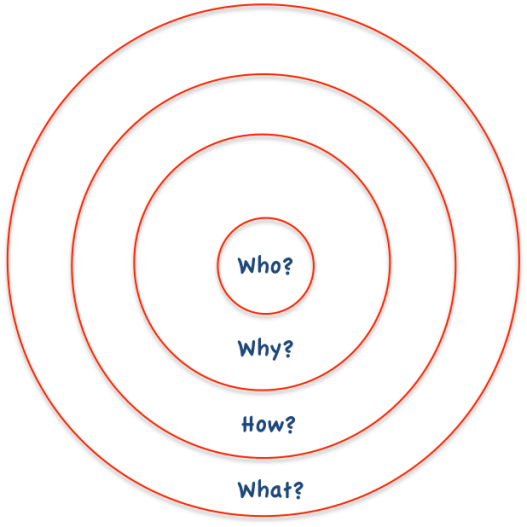
    I will therefore aim to take a leaf from Lex Sisney, who added to Simon Sinek’s Golden Circle – whose original TED talk is available here.

    whats-wrong-with-the-golden-circle-right

    Sinek purports that great organizations seem to create their foundation by first addressing Why they exist, then How they go about their mission, and then finally, What they do.

    However, the truth is that great organizations build their core ideology by first defining and reinforcing Who they serve and the customer problem or need that they solve in the marketplace. Then they address and reinforce Why they exist, then How they go about their mission, and finally What they do.

    Ref: http://organizationalphysics.com/2013/04/01/whats-wrong-with-the-golden-circle/

    Starting from the centre, I can tailor my reporting based on who the audience is first and then work my way out.

    It is highly likely that I will reference this way of thinking again in the future.


    An example of this in our everyday lives as an audience, or consumer (the Who or consumer), can be seen in newspaper headlines, or even newsletters, such as the Ministry of Testing, Testing Feeds.

    The data is there, if we want it, but for the highlights we can browse. If something draws our attention we can delve in deeper. Flipboard, Buzzfeed, Twitter, click bait et al operate in this modus operandi.


    So the take away from this for me, is to think about what reporting data there is to collate, from whom and for whom, then how to present it.

    I don’t want a paperwork overhead, but I want to know what has been tested, I want for there to be transparency in the testing work that is carried out in my workplace, and for this process to continually improve and be beneficial.


    Blog post title lyrics from: Lost and found – by Train.

    Find all the songs from my blog posts at this Spotify playlist.

  • In the name of understanding now…..

    In the name of understanding now…..

    …..Our problems should be shared

    Following on from Work it Make it Do it Make us….. this post relates to the afternoon workshop that I attended at TestBash Brighton 2017, ‘Coaching Skills To Unlock The Potential Tester In Everyone!’ as led by Toby Sinclair and Amy Phillips.


    This session was so different to the morning workshop, but equally engaging and fulfilling.

    We started in groups around a table, with a spread of pens, post-its, pipe cleaners, so we knew it would be interactive.

    Everyone was presented with the agenda for the workshop in a totally different way to any I’d ever seen.

    If there was any danger of a post-lunch lull, this soon woke me up and the promise of a visit to the ‘Island of Coffee’ along the way was very exciting.


    Amy and Toby presented well together and the idea of coaching (as opposed to mentoring) was introduced to us.

    Further reading at Toby’s blog.

    After sharing our thoughts on coaching in our groups, a coaching session was demonstrated.

    We were always given the time and space to reflect on each section and could discuss and make notes as we went. I went a little post-it crazy.


    Toward the end we were able to try out coaching in our groups (at Hot Seat Volcano), where the coachee would briefly introduce us to a scenario form their work and then the other members of the group would take it in turn to ask short questions, then the coachee would write them down (instead of answering, in this instance) to reflect on later.

    I even visualised the coaching stance that Toby went through, in my attempts to practically take on-board Huib’s workshop that morning.

    20170405_153646

    After three rounds of each ‘coach’ in the group of asking questions, the coachee was able to give some feedback, although not specifically answering the questions.

    Then, I got a go in the hot seat.

    My intro was short, I have a lot going on at work and it can be a juggle, I’m good at identifying where there can be a need for improvement, or a process, or other.

    I came away with 15 questions on which to reflect.

    1. Is it self-inflicted?
    2. Have you ever identified a problem and not proposed a solution? If so, how did you feel about it?
    3. What is the difference between my team and the other testers’ teams?
    4. Do you actually feel forced to identify a problem?
    5. Is this a behaviour in all areas of your life, or is this exclusively with testing?
    6. Within the four teams, are there others who could take on these responsibilities?
    7. Do you feel unburdened of a problem, once you’ve resolved it?
    8. Could you describe the team members’ expectations of you?
    9. How do you feel when you don’t have a solution?
    10. How do you feel others (especially team members) feel about what you do?
    11. How do you think you’re helping your teams?
    12. What burdens more, the problem, or finding the solution?
    13. How do you prepare your teams when you go on holiday?
    14. Are there people in comparable positions? How do they deal with it?
    15. Do you take these problems to certain people?

    Along with these questions, I came away compelled to think more before offering my advice or opinion and felt challenged to be a better coach in my everyday.


    Blog post title lyrics from: Confide in me – by Kylie Minogue.

    Find all the songs from my blog posts at this Spotify playlist.
  • Work it Make it Do it Make us…..

    Work it Make it Do it Make us…..

    …. Harder Better Faster Stronger.

    TestBash Brighton 2017 delivered so much, there have been some pretty comprehensive blogs about the conference day already. A good example of which is:


    I’m going to concentrate, for now, on the workshops I attended on the Thursday.

    As I mentioned in Look around you, do you see those faces…..

    Essentially, conferences should be there to provide recharging of batteries, new ideas, reassurance and a fresh testing perspective.

    For this blog, I’m going to concentrate on the morning session ‘Thinking and Working Visually for Software Testers’ as led by Huib Schoots.


    As a side note Del Dewar covered the correct pronunciation of Huib’s name on the Friday.


    I am no artist and yet I find myself drawn to diagrams, flow charts, mind maps and such, as opposed to written documentation. I think I even took one of those online tests (super credible) and it suggested I was a visual mathematician, whatever that means.

    For me, I was looking for any techniques and tips to be able to use some of these in my day-to-day work.

    Huib got us to start drawing straight away, but not before asking us to describe, in pairs, our house to each other. Then, taking a short while to sketch our homes and repeating the exercise again.

    This immediately highlights the power of pictures, no matter how badly we draw them, the mental picture one can create with these stimuli outweighed the power of words.

    Examples were given, from IKEA instructions to road signs.

    Huib allayed fears of not being able to draw, empowering us all to express ourselves however we could and encouraging us to practice simple things. As with anything, practice can make perfect passable.

    We were pointed to The Sketchnote Handbook for further reading.

    The session gave us the chance to try:

    • Sketchnoting to TED talks.
    • Design test cases in flowchart form.
    • Using mindmaps to present, in pairs, ourselves to each other in pairs.
      • Huib showed us his CV in mindmap form.
    • Mindmaps as test plans.
      • Mindmaps into test cases.
    • Session notes – note-taking for conferences and classes.
    • Test coverage outline – this is something I’ve been trying to get my head into since I started at my current role last summer.
    • James Bach’s Heuristic Test Strategy Model and SFDIPOT (page 4).

    There was so much to takeaway from this session and my head was spinning.

    I must confess that I didn’t take session notes in any of the talks, which meant that I wasn’t able to start processing all that I had taken in until I got home.

    The slides contained more than enough reference material to keep me busy for weeks, but even with just the session as a stand-alone point of reference, I will:

    • Present more ideas in sketch form.
    • Keep a note book with me, to capture thoughts as and when they come rather than trying to do so retrospectively.
    • Try test strategy/plans/coverage in mindmap form.
    • Play with flowcharts, handwritten and online, more.
    • Try to communicate better, and more visually!

    Thank you Huib.


    Blog post title lyrics from: Harder, better, faster, stronger – by Daft Punk.

    Find all the songs from my blog posts at this Spotify playlist.

  • Look around you, do you see those faces…..

    Look around you, do you see those faces…..

    …..what do those faces tell you?

    What are the benefits of attending conferences?

    1391180282702

    I won’t lie to you, conferences can be a lot of fun, but they can also be a drag. There are lots of things that make up a good conference experience, including:

    • Good presenters
    • Good venue
    • Relevant topics
    • Fostering a sense of community

    So, why do I attend conferences? Will anything change at work when I go back to the office?

    I touched upon conferences in an earlier blog, All I know is I’m lost without you….

    not only had I never attended any conferences or meetups, but that I had absolutely no awareness of the wider software testing community, practices, ideas, heuristics, blogs or anything that is so cool about being a part of the software testing community.

    With the greater awareness of community, not only is there a sense of belonging to something bigger than just your own local environment, but also a wide resource of help, support, information, sounding boards and so on. Ministry of Testing has Slack which is a great resource, but nothing can beat human interaction.

    This year I’ll be attending TestBash Brighton, for two days, structured as two half-day workshops and then a single stream of talks.


    From last year’s conference I took Lego Automation back to my office, as I touched upon on World Book Day, I’m not afraid, they can read all about it…..

    I also learned about Test Mobbing and Pairing, and we have tried that here too, blogged about here – One thing I can tell you is you got to be free…..

    Not to mention a whole smorgasbord of new Tweeters to follow.


    Essentially, conferences should be there to provide recharging of batteries, new ideas, reassurance and a fresh testing perspective.

    If you don’t get that from the conference you attend, you should try another.

    TestBash-Brighton-Attending-Badge


    Blog post title lyrics from: Faces – by 2 Unlimited.

    Find all the songs from my blog posts at this Spotify playlist.

  • I don’t wanna waste another day….

    I don’t wanna waste another day….

    …..stuck in the shadow of my mistakes.

    This is a brief tale of how I learned to take a little more responsibility in my job.

    As testers, I believe that we have to be advocates for quality, we cannot force it, but we can and we should be straight shooters and we should say it as we see it.


    When I was new to testing, in the games industry, I didn’t really understand the role of a tester, we weren’t allowed internet access and worse than that, had next to no interaction with the development team. My friends thought they knew what I did though, a lot of misguided ideas about bean bags and such.

    These days, I like to think I know what I’m doing most of the time. And now my friends have no idea what I do. Still no bean bags.

    That’s not the only thing that has changed.


    The test team on my first project was pretty big, around thirty testers. We were a real mixed bag, but indisputably gamer types.

    There were a few in the team who took bug count to be the biggest badge of honour, seeking quantity over quality (if you can class one bug as better than others).

    In lieu of this observation, in my own naivety, I decided not to partake in this competition and would intentionally ignore bugs, leaving them for the bug-hungry, as I sought meatier bugs.

    Upon release, I noticed there were bugs that I had seen, bug ignored in the release version. This was before the days of day one patches and DLC, the released product was the only release.

    Not my proudest achievement in life. And, I didn’t own up to it.


    Coincidentally, Gerald Weinberg tweeted this Einstein quote (I Googled it to verify and Reddit confirms it – who doesn’t trust Reddit after all?), and it resonated with me.


    My first tester role outside of the games industry, presented me with the opportunity to maintain a large automation suite.

    A lot of this work required analysis, maintenance and updating of the various test cases that were executed on a nightly basis.

    Many changes were being made to the code base and the automation was there to catch defects quickly. On occasion, there would be merges that meant a lot of tests failed.

    When there are failures en masse, it is possible that other failures are masked, and this was true of this scenario. It took me three weeks to realise that a suite of failures were not down to this one problem.

    This time, however, I reported the issue in TFS, raised it with the scrum master and informed the team in the stand up. When pushed for a reason that this hadn’t been reported sooner, I had to hold my hands up and admit the fault was mine.

    A moment’s embarrassment was a little unpleasant, but for the sake of the quality of the end product, it was the right thing to do. And I didn’t have the guilt that comes with ignoring these issues.


    We will all miss bugs, but to intentionally do so can only be detrimental to the quality of our end product. It isn’t necessarily only our call as to whether issues will be fixed or not, but we should always find the time to raise them. If anything, this can be an issue sometimes for me, in this age of distraction and managing it can be hard. But, I’m getting better at it than I used to and I’ll continue striving to improve.


    Blog post title lyrics from: What’s left of me – by Nick Lachey.

    Find all the songs from my blog posts at this Spotify playlist.

  • So don’t be afraid to let them show….

    So don’t be afraid to let them show….

    ….your true colours.

    This weekend was a landmark occasion for my eldest son. Ever since he has understood what a car wash is, he has campaigned that my car be washed. In fairness to him, I hadn’t washed it in 3+ years!

    Some people have a love affair with their cars.

    Others view them as a functional means to get from A to B.

    I drive one of these:

    $_86

    It does a job, it doesn’t break down and it is cheap to run.

    For the average person, this is not a desirable car. In fact, I have worked with people that refused to take a ride in it. So, double the undesirable nature of the car, with the fact that it hadn’t been cleaned in so long.

    This was not a product designed to be lusted after by petrolheads.


    As I was cleaning my car, it reminded me of a project I once took part in, to ‘upgrade’ an automation test suite.

    We worked with a third party to complete the integration and my role was to initiate a review procedure to ensure quality.

    The process consisted of two separate reviews, one for technical functionality and the other for best practice conformance.

    The first process was to ensure that the scripts did what they were designed to do, and as well as possible. This we can all relate to and is fundamental.

    The second is perhaps not one that we see all of the time, or is seen as the lesser of the two more often. That is the look and feel of the scripts.


    It is very easy to want to release something as soon as it works, we live in a world of instant gratification after all.

    But as end users, how much do we appreciate something that looks as good as it works?

    A comment that stuck with me from one of the team that we worked with was how impressed they were with our commitment to both processes. He likened it to a car, with both wonderful performance and drive, but also that looked spectacular.

    We shouldn’t judge a book by its cover, but consumers want something that looks and feels good to use.

    I want to feel proud of the products that I work on, I want others to see that product and how good it looks and to experience how good it is to use.

    Kate Veatch: I’m curious, is it strictly apathy, or do you really not have a goal in life?
    Peter La Fleur: I found that if you have a goal, that you might not reach it. But if you don’t have one, then you are never disappointed. And I gotta tell ya… it feels phenomenal.
    Kate Veatch: Well I guess that makes sense, in a really sad way.

    From Dodgeball: A True Underdog Story

    I want to have my cake and to eat it, if we don’t strive for the best, then we will never achieve the best.

    I guarantee that if I had a car that I took more pride in, I wouldn’t need to wait for my son to prompt me to clean it again.


    Blog post title lyrics from: True colors – by Cyndi Lauper.

    Find all the songs from my blog posts at this Spotify playlist.

  • I’m not afraid, they can read all about it…..

    I’m not afraid, they can read all about it…..

    ….read all about it

    So, it’s World Book Day. I wanted to share a quote from my favourite book with you, it comes from Sophie’s World by Jostein Gaarder.

    Why is Lego the most ingenious toy in the world?

    For a start, Sophie was not at all sure she agreed that it was. It was years since she had played with the little plastic blocks. Moreover she could not for the life of her see what Lego could possibly have to do with philosophy.

    But she was a dutiful student. Rummaging on the top shelf of her closet, she found a bag full of Lego blocks of all shapes and sizes.

    For the first time in ages she began to build with them. As she worked, some ideas began to occur to her about the blocks.

    They are easy to assemble, she thought. Even though they are all different, they all fit together. They are also unbreakable. She couldn’t remember having seen a broken Lego block. All her blocks looked as bright and new as the day they were bought, many years ago. The best thing about them was that with Lego she could construct any kind of object. And then she could separate the blocks and construct something new.

    What more could one ask of a toy? Sophie decided that Lego really could be called the most ingenious toy in the world. But what it had to do with philosophy was beyond her.

    Now, I’ll leave the philosophy to Jostein Gaarder, you can read more here.

    My point here is the association of Lego and testing, more specifically that of the Lego Automation workshop ran by Richard Bradshaw (@friendlytester), you can read more about it here.

    He ran it at TestBash Brighton last year. I was in attendance and it was excellent.

    This was the session I attended.

    I took this session back to my office last year and ran it with a team of testers, it was very engaging and I believe that there were a lot of really useful lesson learnt, to help us to become smarter testers!

    He is running this session again at TestBash Brighton 2017, if you get the chance to, I would strongly advise that you go along.

    I know he runs these sessions all over, so don’t worry if you’re not going, just keep your ear to the ground, he’ll run it again, then sign up!


    Blog post title lyrics from: Read all about it, Pt. III – by Emeli Sandé.

    Find all the songs from my blog posts at this Spotify playlist.

  • Be sure before you close that door, before you roll those dice……

    Be sure before you close that door, before you roll those dice……

    ……Baby think twice.

    Automation in test is wonderful, it can be time-saving, it can find bugs early in development and it can run when you’re not even clocked-in. But, there can be a lot of misconceptions about automation in test, or even whether you consider it testing or checking:

        Testing is the process of evaluating a product by learning about it through exploration and experimentation, which includes to some degree: questioning, study, modeling, observation, inference, etc.

        (A test is an instance of testing.)

        Checking is the process of making evaluations by applying algorithmic decision rules to specific observations of a product.

        (A check is an instance of checking.)

    Ref: James Bach

    In my experience, you can have too much of a good thing, I have a metaphor, so bear with me. At home, my children drink a dilutable cordial/squash, to ‘make water taste better’. This comes with a recommended water to squash ratio, let’s say 5:1. If I reduce the ratio of squash to water to be 1:10 , the taste is less acceptable, or conversely, if I increase the proportion of squash to water, it can become too strong and unpalatable.

    My end goal is to not see this face when they have a drink:

    dsc02900

    That is one unsatisfied customer!


    The point here is that we need a mixture of testing heuristics, a balance in order to achieve the most coverage of code tested or checked.

    James Bach again has a great outline of testing heuristics here.

    Sports analogy time…..sort of

    I play table football in my lunch break sometimes. I am a one-trick pony with this game, I can hit the ball pretty hard. However, if the opposing player blocks my shot, they may score, and I almost certainly won’t. My point is that if there is only one point of attack, then I’m not testing the defence of my opponent, it’s undynamic and predictable. But, it does feel good when I score. So, I’m not suggesting that I ditch that tactic completely, merely that I diversify.


    I am going to blog at a later date on designing an automation project/framework, but for now, here are the key points:

    • No single solution will best test your software, please don’t invest in 100% test automation
    • The right mixture of heuristics will depend on you as testers, your software, tool availability etc
    • Consider what it is that you check and what you test
    • Think about where you can get early ‘wins’ with your automation, e.g. time savers
    • Don’t automate for the sake of it
    • Learn more, explore more, find your balance and don’t get complacent

    Blog post title lyrics from: Think twice – by Céline Dion.

    Find all the songs from my blog posts at this Spotify playlist.

  • One thing I can tell you is you got to be free…..

    One thing I can tell you is you got to be free…..

    ……come together, right now…….

    Having decided to carry out a test mob on a new product at work; I blogged about the plan last month; last week we finally held our inaugural test mob.

    This is our experience of mobbing.


    The room was set-up thus:

    • Testers
    • Tester fuel (healthy and sugary)
    • Test environment
    • Test note taking ‘tools’ (digital – Plumbago/paperful/post-its)
    • Test ideas board

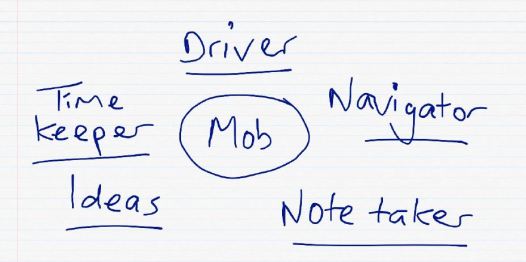
    As there were five of us (from four different teams), we had five different job roles:

    capture

    • The driver would be at the laptop, driving the test environment
    • The navigator would guide the driver as they tested, taking their lead from the ideas on the ideas board
    • The note taker took the digital notes
    • The ideas board person took the ideas from the team and added them to the ideas board via post-it, rearranging by priority, or as tested
    • The time keeper would keep track of the time boxed sessions and keep the whole thing rolling.

    NB: Each role should not be exclusive from each other, but to enable all key areas to have a person responsible for them.


    We had three hours in total, after the room was setup, testers adequately fuelled and an initial intro to the new product, we started with a 15 minute sessions in each role responsibility before cycling through.

    At the halfway point, we took stock, ideas for test areas and a quick recap of the notes made.

    Then we started the cycle again.


    So, how did we find it?

    Well, we ran a retrospective the very next day as part of our monthly test team meetings with some good points made:

    Good:

    • Team bonding
      • Learning how we all test differently, how we all have different experiences with the product.
    • Learning a new product
    • Learning new features of the existing product
    • Fun
    • Lots of bugs found

    Bad:

    • Some people deviated from their role of responsibility (I may have been guilty of that myself once or twice)
    • The time keeper was bored
    • Post-mob process undefined
      • Bugs found were only recorded in notes
      • Bugs found did not necessarily have steps of reproduction recorded
      • The responsibility of entering the bugs was not outlined in the mob session

    Improvements:

    • Addition of extra laptop(s), so that bug entering, tracking and research can take place then and there
    • More flexibility in the roles, there’s always something we can do
    • Longer time in each role rather than repeating

    It was a very productive retrospective session and we all agreed that we would want to run another test mob in the future, when we next have a new feature or product to test.

    In hindsight, we went in rather unprepared to the unexpected. But, we all bought into the concept, and have started to shape it in a way that can work for us as a team of testers across different teams, but also to increase eyes on an unreleased product with new ways, thoughts, heuristics preferred and (human) testers’ intuition.


    Blog post title lyrics from: Come together – by The Beatles.

    Find all the songs from my blog posts at this Spotify playlist.