
Blog

  • Let’s get ready to rhumble….

    Let’s get ready to rhumble….

    ….get ready, get steady, and rhumble.

    Ok, so the links between old songs and the theme of the blogs continue, I apologise, but I’ll continue.


    I am unashamedly enthusiastic about my family, my job, what I do with my time, where I go and what I find truly gripping. Inspiration can come from all walks of life, and late on Sunday night, I was motivated to write this blog.

    The subject, another crossover observation (see my previous blog on crossover of church and software development, here), but this time the crossover is none other than pro wrestling and automation, because we can learn from anything, right?

    I was watching the WWE Royal Rumble and this is the outcome. So, I’ve broken it down into eight subjects, this is a broad brushstroke across it, but hopefully stimulating:

    1. Milestones
    2. Evolution
    3. Nay sayers
    4. Passionate evangelists
    5. Rules
    6. Observations
    7. Misconceptions
    8. Conclusion

    Milestones

    While the wrestling calendar is changeable, there are some mainstays. WWE operate on an annual build up to their biggest event Wrestlemania, other organisations are available, such as NJPW’s Wrestle Kingdom or TNA’s Bound for Glory.

    What these events represent are (hopefully) the culmination of weeks, months, even years of build-up to a (hopefully, again) satisfactory climax and conclusion to a storyline. These events are when more eyes are on the product than at any other time in the cycle.

    In software, we look to have satisfied the testing requirements on a product prior to release. We have stories that build, ebb and flow throughout the product life-cycle before final execution and eventual final release to the masses.

    *other observations are:

    • it’s scripted, but those scripts need to be maintained and updated accordingly.
    • there should be consistency across the board, but that’s not always the case.
    • sometimes stories inexplicably end and are dropped, never to meet a satisfactory conclusion.

    Evolution

    Wrestling today is not like it was in the past. I grew up with Ultimate Warrior and Hulk Hogan feuding and it was magical, but if I watch it today, it is a tad low rent in all honesty. If the product was the same today as it was then, it would likely be out of business by now, embracing change is the only way.

    In the same way, there are so many new wrestling organisations, to meet the needs of the different fans, for whom the headline product just doesn’t cut the mustard. Shout out to ICW in particular.

    Automation tools have to move with the time or they risk being made redundant very quickly. Whether that’s drivers, .net support, OS compatibility or target market. Software developers, while sometimes fiercely loyal, can also be fickle (which I think is an oxy moron, please correct me if I’m wrong), if the tool doesn’t meet their needs, they’ll find a new one, or make their own tool.

    *other observations are:

    • A different setting, will have different needs and requirements, just because it works in one setting, doesn’t mean that it will work elsewhere.
    • Obsolescence can be overcome with a little creativity and freedom.
    • Legacy, if shoved down our throats can grate and put people off, the same with predictability.

    Nay sayers

    Have you ever met someone who things that pro wrestling is utter tosh? I bet you have, heck you probably think so yourself.

    There are an awful lot of people who feel the same about automation.

    Does this mean that the nay sayers are wrong? That they’re just out of touch?

    Maybe, but I doubt it. It’s all a little subjective.

    Either way, it can be very difficult to convince these people otherwise, convert if you will…..

    Passionate evangelists

    …this invariably leads to the natural opposite, the passionate evangelists. Those who are hell-bent on automating everything in sight.

    Not only will they promise the world, but they’ll try and sweep you up in all the excitement. Just like they pro wrestling fan who you see on the edge of their seat, wearing their fresh new merchandise, cheering for the babyfaces, booing the heels, total marks!

    Enthusiasm is contagious and a wonderful thing, that passion can go a very long way.

    But, maybe it’s just me be a bit of a realist, but I see pro wrestling and automation for what they are and where they fit into my life, and where they might have limits.

    Pro wrestling cannot be my main focus for entertainment, not least because any spare leisure time that I have, I share with my wife and she could not care any less about pro wrestling, seriously!

    Automation has its place too, in the cycle of testing, I enjoyed reading Viktor Slavchev‘s take on this in his blog The non-manual, unautomated tester.

    Neither is the be all and end all.

    Rules

    What do we get when we code without rules? Code that no one wants to work on, or that no one knows how it works. The kind of thing that people say is bin-worthy and should be started all over again.

    Automation works when there are rules, good practices, sensible practices that others can follow.

    Pro wrestling sometimes has some pretty flaky rules, and for the most part, any gimmick matches that were hard to follow have been consigned to history. But, if you’re truly interested in something that is a terrible examples, take a look at WhatCulture Wrestling‘s article.

    It’s bad and cringe-worthy.

    Observers

    I’ve already mentioned WhatCulture Wrestling, they have a fairly tongue-in-cheek approach to things, but there are some truly serious and dedicated commentators on pro wrestling. Some of these are highly regarded, such as Dave Meltzer others not so much. But, if there’s an opinion that you have, you can probably find one to support yours online.

    There are some heavily polarised opinions on automation and wider software testing out there too. Where to look for inspiration and balanced opinion is hard these days.

    With targeted clickbait and news that some wonderful algorithm out there has picked out for me, no wonder there’s such a smorgasbord of opinion out there.

    Wisdom dictates that a balanced digest from different sources will help you to find your own place and where you stand. So read, a lot, educate yourself and find where you stand.

    Maybe that’s a little deep for a blog that’s talking about pro wrestling and automation?

    I digress.

    Misconceptions

    I’ve touched upon this already, but I’ll say it again, 100% test automation is not possible. If all your tests are automated, what are you testing? What do the testers do with their time? Where is the dynamism? The intuition? What makes a tester, test?

    Pro wrestling isn’t real? Well, I think they’re really wrestling, I know they’re really strong and I know they get really hurt. Yes, they may have predetermined endings, but I guarantee they hurt.

    *more observations:

    • Some wrestling is performed so badly, yes your grandma could probably do a better job.
    • Some automation is a massive waste of time and a maintenance nightmare. Why do we automate? What is the end goal? We should plan for what the requirements are.

    Conclusion

    Thanks for making it to the end.

    My final thoughts on this are:

    • Legacy is important, but we have to move on, nostalgia is the only reason Ric Flair was still around for so long, no one wanted to actually see him wrestle.
    • Automation, as was, even five years ago, has moved on. We have to update, maintain, evolve our automation to stay relevant.
    • The biggest name isn’t always the best.
      • Hulk Hogan was not the best wrestler. We’re not all supposed to have the same favourite.
      • LabVIEW is a wonderful test tool, but it doesn’t mean that it’s going to be the best solution for me. Find a tool that meets your requirements, once you know your requirements and not the other way around.
    • It doesn’t matter if you think something might be embarrassing, your thoughts are valuable, your passions are what make you who you are and that is something to be celebrated.
    • Crow Sting was my wrestling hero.

    Blog post title lyrics from: Let’s get ready to rhumble – by PJ & Duncan.

    Find all the songs from my blog posts at this Spotify playlist.
  • All I know is I’m lost without you….

    All I know is I’m lost without you….

    ….I’m not going to lie.


    In the name of maintaining relevance, I have added to each section of this blog, to reflect how remaining relevant isn’t a static thing. Any new content, I’ll add in italics.

    Nov 2018.


    The whole point of starting my blog came about as a result of some self-reflection. We have recently been recruiting new testers.

    Throughout this season of recruitment, I found myself drawn to reflect on what we want in a tester and I found a really nice blog on this subject by Dan Ashby, take a minute to give it a read, I really like the mind map, it’s a very stimulating conversation tool.

    The node within the mindmap that challenged me most and caused even the inception of this blog page was the node ‘Remaining Relevant’. I really had to think about what that meant to me and also how long I had been testing software before I would be someone that could reasonably have spoken on any of these subjects:

    • Last conference/meetup attended
    • Keeping up to date with the industry
    • Favourite testing book or blog
    • Personal blog/Twitter

    But now, what do they mean for me? How would I address them for myself?

    Last conference/meetup attended

    Obviously this could be answered just by saying ‘last March at TestBash – Brighton’ but I would hope that I would be able to show awareness of conference(s). What happens at them, what benefits can be gleaned from attendance and so on.

    For me, attendance at EuroSTAR 2013 was a huge eye opener. Even though I started as a tester in 2004, I saw nothing outside of computer games QA until 2012. Even the idea of transition out of the games industry into the wider software testing world seemed to be a rather huge tangent. As this paragraph is from the crux of this blog….

    The point is that not only had I never attended any conferences or meetups, but that I had absolutely no awareness of the wider software testing community, practices, ideas, heuristics, blogs or anything that is so cool about being a part of the software testing community.

    Since EuroSTAR came into my life, I’ve realised what conferences are, the people that you meet and the value of the sessions run, the conversation and debate. It’s all so stimulating and refreshing.

    I have since attended National Instruments’ Automated Test Summit and TestBash Brighton and can attest to the benefits. I will touch on this more practically in another blog in the future.

    As for meetups, that is something that I have not yet managed, maybe part of that is a convenience issue, I have two small boys and I live in rural South Kesteven, I will endeavour to look harder and maybe even look to start one, if I’m feeling game.

    Having written this, I have attended a TestBash, UKSTAR and two EuroSTARs (hosting the Community Huddle in the later two.

    I also have attended and even hosted an MoT Meetup, with my colleagues. I know that there are a lot of passionate testers out there who give up their free time to arrange and host these events; from sponsors, to hosts, arranging guest speakers and everything that goes along with that. I wholeheartedly endorse looking these up. https://www.ministryoftesting.com/ministry-of-testing-meetups

    and while we’re at it, if you want to nominate a meetup hero, please take a look at https://ukstar.eurostarsoftwaretesting.com/ukstar-software-meetup-hero-competition/

    Aside from TestBashes and STAR conferences, there’s the unicorn loving Agile Testing Days, and countless others. Conferences provide an opportunity to hear new ideas, meet some heroes of the testing world, bring new and exciting ideas back to your work place.

    Keeping up to date with the industry

    The internet is the best way to stay connected and up to date with things.

    Twitter is amazing, I don’t use it anywhere near its potential, but when I find a blog, hear a talk or get referred to someone who might have something to say about software testing, I will follow them on Twitter.

    Incidentally, my handle is @christovskia I may even tweet more than links to memes, my blog posts, Eurovision, TdF or Superbowl, feel free to follow me and find out.

    Also, signing up for email post from the likes of Test Huddle and the mighty Ministry of Testing, is a great way of getting updates without even having to try.

    On the subject of Ministry of Testing, they sent out a great post 30 Things Every New Software Tester Should Learn that is well worth a read.

    And finally, Flipboard where you can follow various topics and share interesting articles. Ministry of Testing share yet more great stuff there too.

    For me, I find some blog posts that look interesting and leave them open in my browser and dip in and out as and when I can. I find inspiration and support in these blogs.

    Almost as soon as I published this blog initially, Slack became a thing I needed to be a part of. Ministry of Testing host a great Slack which is the most wonderful celebration of testers and a great resource at your fingertips, https://www.ministryoftesting.com/slack_invite is where you should go to check it out.

    Favourite testing book or blog

    This is totally subjective, I don’t really read many testing books per se. But, as above, blogs are my thing.

    Examples of mine spread from Maaret Pyhäjärvi to James Bach.

    In the MoT Slack, there is a #blogs channel that I would recommend. I can at least now recommend a book,  Dorothy Graham‘s new book along with Seretta Gamba, aroud test automation.

    Personal blog/Twitter

    I’ve noticed more as I’ve written this that I’m going to be repeating myself a little here, but I tweet a little, and I write this blog. The blog is shared on my personal Twitter, Facebook and LinkedIn pages.

    It goes without saying that I am representing myself and there is an obvious association made with my employers. The representation of myself on social media and via blogs can be supremely advantageous for both parties, but can also be a deal breaker, not only with current employers, but any potential future employers.

    For that reason, I may be quirky sometimes (for want of a better word), but I try to be mindful of the reception that could be greeted by anything I may post online. This is something that I have become more conscious of since the early days of my social media existence, but worth bearing in mind which posts are publicly viewable.

    I have found myself more recently trying my hardest to follow more testers on Twitter, I have made some great connections and seen so many great debates. It is true that you can find yourself only following people that have the same opinions that you do, but without contrast, we can’t learn so much. So I would recommend following people that you might not be able to resonate with, maybe when you find something that you disagree with on a point, you’ll discover what you really believe in?

    Twitter has been my main source of new ideas and blog posts, but also podcasts. Having had a short discussion with some testing peers last week, we shared some that I think are worth recommending here:

    Gem Hill‘s Let’s talk about tests, baby – https://letstalkabouttests.xyz/

    Alan Page‘s AB Testing Podcast – https://www.angryweasel.com/ABTesting/

    Stephen Janaway and Dan Ashby‘s Testing in the pub – http://testinginthepub.co.uk/testinginthepub/

    James Espie and Dan Barrow‘s Super Testing Bros – https://www.supertestingbros.com/podcasts/

    And, the Guilty Tester Podcast – https://theguiltytester.libsyn.com/


    So, please stay in touch, let me know your thoughts, tap in to the industry, be inspired and inspire!!


    Blog post title lyrics from: Lost without you – by Delta Goodrem.

    Find all the songs from my blog posts at this Spotify playlist.

  • I predict a riot…..

    I predict a riot…..

    …..well, a mob to be more precise.

    Taking inspiration from TestBash 2016 and this presentation, I have been looking for an opportunity to give a test mob a proper go. At the turn of the year that wasn’t possible as I was in a globally distributed team and I didn’t want my first mob to be a true logistics nightmare. I have presented the idea of test pairing and mobbing in the last couple of rounds of interviews we have had here and it’s had garnered some interest, so then it was just a case of waiting for the right opportunity.

    A new product release of software as an opportunity for us to all try this for the first time.

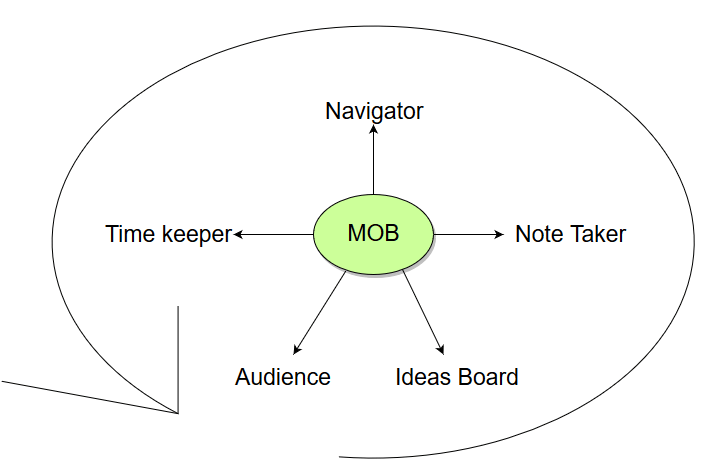
    With any of these things I’m keeping it to my own interpretation and we’ll see how we goes. Below is a diagram of how I anticipate us setting it up with a rotation of roles as we go along:

    mobdiagram1

    We have a team of six testers across four different teams, so it should be a great chance for us all to get together and test. I am looking forward to learning more about the product and how all us testers approach testing, I hope to find new and interesting ways to approaching the testing of our products as well as getting to know the other testers in a more professional way.

    I will follow up after the Mob has completed its session!

    Follow up blog here.


    Blog post title lyrics from: I predict a riot – by Kaiser Chiefs.

    Find all the songs from my blog posts at this Spotify playlist.
  • An ode to legacy code

    An ode to legacy code

    This right here is an ode

    An ode to legacy code

    If you didn’t write that blessèd script

    With its comments, I guess, locked away in a crypt

    The syntax makes no sense

    Trying to understand it makes you feel tense

    There is more than just its appearance that irks

    Somehow, that code still works

    It’s time to add a new feature or upgrade

    A time to refresh, rebuild the foundations laid

    Who will take on the code that no one present wrote?

    Who will lose the democratic vote?

    There is more than just its appearance that irks

    Somehow, that code still works

    Maintenance is something that one might try to avoid

    Fixing issues with code that none of us deployed

    What will happen if the compiler breaks

    My sanity, for the ride, it takes?

    There is more than just its appearance that irks

    Somehow, that code still works

  • I’ve got the key, I’ve got the secret…..

    I’ve got the key, I’ve got the secret…..

    …..I’ve got the key to another way.

    Well maybe not quite,  but it’s good to approach problems positively, right?

    Once upon a time (early 2014, to be a little more exact), I submitted an abstract to speak at a test conference. I had no experience in public speaking at test events, but had in other contexts. I thought that I had an interesting topic and I was interested in any feedback that I might have for any future submissions, should the paper not be accepted into the conference programme.

    Inevitably, I had the paper declined and I did not do very much about it. Recently, I’ve been thinking about it, so I thought I’d share with you.

    Here is the general gist to my submission.

    I find inspiration through different experiences and relationships that I have had in my life, and continue to do so to this day. Where something is a success in one context, I like to imagine how that could work in a totally different context. Much like how a chef might one day have said to themself ‘hey, why not put apple sauce with some roasted pork?’ different food groups coming together that makes something delicious and satisfying.

    In this instance, the recipe would take part of the inner workings of a growing and successful church and implementing those practices in a software development environment.

    I volunteered in and was a member of a growing church in Nottingham for nine years. In that time I was part of a focused, motivated, well trained and empathetic community. We knew what we were doing, why we were doing it, how to do it, for whom we were doing it and together.

    Does that not sound like something you would want in an everyday working environment?

    In my experience (not always, I might add) R&D departments can be found to be places where cynicism and demotivation can often rear its ugly head. Perceived bad leadership, micromanaging, poor product, maintenance, technical debt, skill deficit or personality clashes, it can be any mixture of those things. Met with those conditions, I see three options.

    1. Put up with it, bury your head in the sand, turn up and do enough to get paid.
    2. Leave, find somewhere else that works for you.
    3. Do something about it, or at least try.

    Maybe that’s simplistic, but I’ve certainly experienced points one and two before, but it is the third option on which I want to dwell. And that would be where I would look at what it was that I learnt in my church, that I could apply to my work environment.

    Recruiting team members for your team at church was not an easy one, but one of the selling points was always the story behind what your team was there to do, from being a welcoming face to new people, to running car park security. The bigger picture was always outlined and the team were always publicly acknowledged and ran team building sessions, socials and training. Without that in, the focus of the team’s place, team members could quickly lose interest, become unreliable or never join up in the first place. Without the training, they wouldn’t be doing a good job, the thanks and acknowledgement could feel hollow or condescending.

    I am motivated when I am working with people that I know, (hopefully) like, and definitely respect. It’s not easy to get to know people off-the-cuff, generally respect is something that is earned through actions and liking people is a tad subjective. Working within a team, socialising together and learning together, some perhaps even mentoring others, led to a fine team dynamic, it built a trust and in time, a respect for one another.

    There is also a point here that I think is key, there were clear lines of accountability

    learning

    Focus:

    I don’t know about you, but if I don’t know why I’m doing something, I will eventually question it (depending on either how distracted I am, or how enjoyable I’m finding it) and then probably cease to continue with it.

    Within the church, there was always a reason, a purpose to what you were doing. It was emphasised regularly and anyone in that team, if questioned on the reason behind their team’s actions, would be able to give a solid answer.

    I have worked in teams without clear goals, without a charter and without milestones.

    How this can be articulated effectively can differ depending on the audience. But, for me, I find some sort of written or visual representation of mine and my own team’s raison d’être.

    When I started my current job, I polled my peers and relevant stakeholders for how my team was viewed. What they saw as our responsibility. What they thought we did well, and not so well. What we could do to improve.

    That feedback gave me a picture of where my team sat within the company. From that I created a mindmap of the responses (as my visual aid, which now sits on a white board next to my desk for all to see) and created a charter, or declaration of my team’s role. What we would commit to and what we would expect from others. Without this I would have likely been leading blindly, hoping that my previous experience would somehow mean that I would just know what I was doing.

    Direction:

    This isn’t necessarily all that different from focus. Both are goal oriented. Where focus is knowing what you are aiming for, direction is almost more of a transition, a movement toward that goal. How will we get there? What’s the plan for guiding us?

    In the church, taking the setup team as an example, they had a timebox in which they needed to get their job done. They knew what needed to be done (in this instance, setting out chairs for the congregation) and when they needed to get it done by (before the congregation arrived). There were also requirements that they needed to meet, the chairs needed to face the stage, in fact a kaizen event led to a curved seating arrangement where every chair would face a single focal point in the middle of the stage. There were health and safety compliances to consider, number of chairs away from an aisle you sit, width of the aisle etc.

    So, we know our focus, but what are our requirements? Do we have any standards by which we need to comply? Is the plan flexible enough to adapt to any continuous improvement suggestions? When do we need to get the job by and who will approve our work?

    It sounds simple, but the temptation is to always hit the ground running, learn as we go and make a plan on-the-fly. That can work sometimes. But, I would suggest that a well laid plan, with iterative milestones (hello agile..) is a really effective way to work. Without the focus and the knowledge of what we want to achieve, including any compliances, how can we make an effective and realistic plan?

    Sometimes we work without requirements or specifications, it’s infuriating and easy to get lost. But, we can’t sit idly by, we need to seek these things out. What do our stakeholders want? What do our customers want? When? Will they review our plans?

    That was just a bunch of questions really, but hopefully you understand where I’m coming from.

    Motivation:

    We have an end goal, we have a plan, but why would we want to spend our time working for something that we aren’t motivated to do?

    I’ve worked in some places where ask I did was clock watch and do just enough to earn my wages. I’m not proud of that, but I think it’s something that we can all relate to.

    In the church, the work that we did was to facilitate a welcoming, comfortable and approachable environment for both the regular congregation and more importantly, for visitors. I know I’m not just speaking from my experience when I say that some churches don’t feel that way, but most strive to be so and that is only made possible through the work of willing and motivated team workers.

    When I am working in a team, I want to make it a comfortable environment where others are welcome. Because I want to work with people who are comfortable working with me and are driven. I hope that those with whom I’ve worked (and those who I will work with in the future) have felt like they’ve worked with a motivated team mate and that we’ve got a common goal, direction and motivation.

    Community:

    Which leads naturally to community. In classic best man’s speech style, I looked up what the dictionary says community means. I ended up in the urban dictionary, and of course was greeted with the U.S. Sitcom of the same name, but did eventually find a definition.

    An interacting population of like-minded individuals, affecting the identity of the given members and also their cohesiveness. In gaining similar social perceptions gives them a sense of solidarity that may or may not lead in the exclusion of other individuals that do not share one or more of their like-mindedness.

    Everyone on the same page, equal focus, drive, motivation and purpose. There is something really special about a feeling of belonging with like-minded individuals. I don’t think I’d truly experienced this until I made it to university, even then it took a while to work out who I was, what I wanted and being truly comfortable in my own skin.

    It was while at university that I started attending the church that is the subject of this blog. I met loads of like-minded people, people I wanted to spend time with and was comfortable being myself in the company of. It was through these relationships and sense of belonging that my life became intertwined with that of the church.

    The parallels with life in the software development world are clear. Except, to get a job you have to be interviewed. As part of an interview process, you look for people who will fit in with your team, even your company values and dynamic. It is possible that someone who is better qualified on paper, but has an air of an abrasive personality, might not get the job over someone who is less qualified. The soft-skills of personal interaction and communication can often be trumped by qualification. I can understand both sides. I don’t want to work in a team of lovely people who are incompetent, but I equally don’t want to work with highly skilled, uncompromising and unapproachable engineers.

    In the church, team socials were encouraged and often a great way to build team spirit and to build friendships.

    What comes to mind when someone suggests team building?

    How can this process become something organic? Surely this can’t be forced?

    It really is about the people, the personalities and how everyone works together and there certainly is no one way to solve this. I guess that’s where good management/leadership comes from.

    And this leads on to the next point….

    Empathy:

    Do you know what makes your colleagues tick? What winds them up? How to press their buttons?

    This knowledge can be a wonderful tool for those of us who love to avoid conflict, but also those who love to stir and manipulate.

    Sharing is caring, but most people don’t want to share a lot of personal details with anyone who will listen. Often colleagues are people that we don’t want to ‘let in’ or reveal our weaknesses and struggles.

    In the church, accountability was encouraged, not just with anyone, but with someone you wanted to do so with. It is inescapably intimate, when sharing details of things that we each go through. Even the most ‘together’ people will have inner-struggles and going through things by yourself is not easy.

    We see this in software development, where we ask for reviews of our tests or code, or through pairing. Extra eyes present more ideas and hopefully more results.

    It is my humble opinion that pairing and reviewing is essential, supremely valuable and an absolute must, but maybe we need more?

    In a sort of utopian view, I would have a peer with whom I would set aside some regular time to share my struggles at work and maybe if something was going on in my private life.

    Struggles professionally is what I will concentrate on here and I will share with you and go into more detail in future posts. Something for you to look forward to!!

    • Starting tasks, shiny and new, while not necessarily finishing them.
    • Avoiding tasks I find boring or difficult, keeping myself busy to qualify that.
    • Reporting or documenting tests, plans etc. Leaving it to the end.

    And so on.

    If I had a peer with whom this had been shared, they could not only challenge me, hold me to account on these things, but even perhaps offer solutions, people to talk to, documents to read or reference. I would not be left to stew in my own head-in-the-sand avoidance or self-pity.

    This is a two-way street though and requires as much giving as taking, so requires a lot of trust. But, the benefits can be tremendous.

    Training:

    Do you know how to do everything? If so, well done, please help me.

    If I knew how to do everything in my job perfectly, I think I would want to leave, I want to be in a constant state of learning, but I don’t want what I learned to be my power. I want that to be something to share.

    I want to be trained and to train.

    In the church, some teams had tasks that wouldn’t necessarily be easy for anyone to do and as such, would require training. In this instance, I will talk about the licensed bar within the church building.

    That’s right, there was a bar in the church.

    But, pouring a perfect pint, changing barrels and cleaning lines aren’t things that one can just do without requisite training and if you get them wrong, there can be consequences…….I didn’t like spraying beer all over my jeans much.

    So how is training approached in your workplace?

    Is it always ‘classroom’ led?

    Is it on-the-job?

    Is it just in a doc or an online webinar?

    I bet you prefer one to the other. I’m a hands-on guy. Theory is great, but if I’m not using it in practice, I won’t be able to do it down the line. I really appreciate when someone takes the time for some one-on-one training, they demo something, get me to try it and I get to ask them questions on the matter. And, I’m more than happy to do the same for others.

    This isn’t always possible, but I’ll never get anywhere if I don’t ask for help.

    It is one of the first things I would look for in a potential employer, is training offered and readily available? But I would also appreciate the opportunity to pass that knowledge on to others.


    Now that was a long post, I hope it reads ok.

    I don’t know if I’ve raised more questions than answers, but I hope I have stimulated some thoughts and maybe you can improve the workplace in which you work.

    Thank you for reading!


    Blog post title lyrics from: The key, the secret – by Urban Cookie Collective.

    Find all the songs from my blog posts at this Spotify playlist.
  • First blog post – it ain’t what you do, it’s the way that you do it…..

    First blog post – it ain’t what you do, it’s the way that you do it…..

    ….that’s what gets results?

    I’m at a new company, in a new position and now seemed like as good as any to start a blog.

    I have moved from being a small cog in a big machine, to being a slightly bigger cog in a smaller machine. What does that mean for me? Why does this change feel like it’s so much more than any before?

    Small companies are great places to work, it’s so easy to get to know people and the way things work. But, when I started in my new job, I felt a certain unease. Something was missing. I really missed processes. Some of my earliest notes that I made upon starting my new role were about me questioning where processes were, if there were any and where could I find them?

    On a side note, using OneNote or Evernote when starting a new job is a great way to collate thoughts, emails and docs and without them I’d have forgotten most of my questions or at least lost most of my post-it prompts and probably made yet more of a fool of myself than ususal.

    So processes, my close and personal friends, those by whose guiding light I had been following in my working life so rigidly that I had lost sight of what it was I was really doing. If all I am doing is following a set way of working, where is the creativity? Where is the use of a tester’s instinctive approach to a task? Where was the fun?

    I’m not saying that I didn’t enjoy what I was doing, I really did enjoy it.

    I’m not saying that I didn’t think that the processes were bad.

    But, was I restricting myself and others? Where was the expression? Where was the spark? Where was the testing?

    I should say, I spent a lot of time in test automation. I love automation, it can be a time saver a sanity saver and a great resource to share among teams.

    But, it isn’t creative testing, it isn’t a replacement for testing, it cannot replace a tester.

    Bit of a side track there, sorry.

    Back to where I am today. Processes weren’t apparent and testers were still testing, even without a plan, or a strategy or even a way of reporting the testing, what kind of madness is this!?

    My question is this, (and if you’ve made it this far, thank you) what are we sacrificing in the name of process? What is the right balance? I can’t live in a world without process, but equally without creativity and the spark of free testing.


    Blog post title lyrics from: It ain’t what you do, it’s the way that you do it – by Fun Boy Three and Bananarma.

    Find all the songs from my blog posts at this Spotify playlist.